



Forlinx Embedded Technology has unveiled the FET8275AA-C System on Module, a compact computing core engineered to handle demanding edge artificial intelligence and industrial automation workloads. Built around the Qualcomm Dragonwing QCS8275AA processor, the module pairs high-throughput neural processing with deterministic real-time control inside a ruggedized footprint built for continuous deployment.
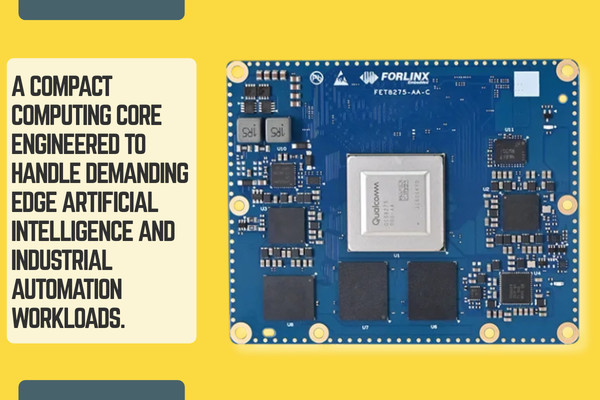
Modern factory floors, autonomous mobile robots, and machine vision inspection lines increasingly require localized intelligence without relying on cloud latency.
By bringing together an eight-core heterogeneous CPU architecture, 40 TOPS of dedicated AI acceleration, and a separate real-time subsystem, the FET8275AA-C targets developers building next-generation industrial gateways, smart cameras, and robotic controllers.
Heterogeneous Processing and 40 TOPS Edge AI Compute
At the heart of the module sits the Qualcomm Dragonwing QCS8275AA system on chip, part of the industrial Dragonwing IQ8 family. The processor divides its compute workload across three distinct CPU clusters to balance peak responsiveness and thermal efficiency.
Two Kryo Gold Prime cores clocked at 2.35 GHz and two Kryo Gold cores running at 2.1 GHz manage heavy application threads, while four Kryo Silver efficiency cores operating at 1.95 GHz oversee background system tasks.
To support data-intensive vision models and multi-sensor fusion, Forlinx equips the board with 12 GB of LPDDR5 memory and 256 GB of UFS 3.1 flash storage. Graphics and video pipelines are handled by an integrated Adreno 623 GPU and video processing unit.
For deep learning inference, the onboard neural processing unit delivers 40 dense INT8 TOPS, allowing engineers to run real-time defect detection, object tracking, and spatial navigation algorithms directly at the network edge.
Dedicated Real-Time Control and Time-Sensitive Networking
Industrial automation hardware frequently struggles when general-purpose operating systems share resources with strict timing loops.
Forlinx addresses this challenge by leveraging the silicon’s dedicated four-core real-time subsystem, which operates independently alongside the main Linux 6.18.44 environment.
This isolated domain provides direct access to up to 68 general-purpose input/output pins and four CAN-FD interfaces, enabling low-latency motor control and sensor polling without jitter from high-level AI workloads.
Networking follows the same industrial focus, incorporating an SGMII interface supporting up to 2.5 Gigabit Ethernet alongside an RGMII port, complete with Time-Sensitive Networking capabilities to synchronize deterministic traffic across factory equipment.
High-Bandwidth Vision and Expansion Interfaces
Measuring 90 mm by 73 mm, the FET8275AA-C connects to custom carrier boards through a 699-pin Mirror Mezz board-to-board connector.
Despite its compact dimensions, the module exposes extensive multimedia and peripheral expansion options suitable for multi-camera deployments.
| Specification | Details |
| Processor | Qualcomm Dragonwing QCS8275AA (2x Kryo Gold Prime at 2.35 GHz, 2x Kryo Gold at 2.1 GHz, 4x Kryo Silver at 1.95 GHz) |
| AI Acceleration | 40 INT8 TOPS (Dense) NPU |
| Graphics and Video | Adreno 623 GPU and Adreno 623 VPU |
| Memory and Storage | 12 GB LPDDR5 RAM and 256 GB UFS 3.1 ROM |
| Real-Time Subsystem | Dedicated 4-core RTSS with 4x CAN-FD and up to 68 GPIOs |
| Networking | 1x SGMII (up to 2.5GbE) and 1x RGMII with TSN support |
| High-Speed Expansion | 1x 2-lane PCIe Gen4, 1x 4-lane PCIe Gen4, 1x USB 3.1 Gen2, 1x USB 2.0 |
| Camera and Display | 3x MIPI CSI (up to 93 Gbps total in C-PHY), 1x MIPI DSI, 1x DisplayPort 1.4 |
| Operating Environment | Industrial temperature range from minus 40°C to plus 85°C at 24V DC |
| Form Factor | 90 mm x 73 mm with 699-pin Mirror Mezz connector |
| Operating System | Linux 6.18.44 with USB Type-C flashing support |
For high-resolution optical inspection, the three MIPI CSI interfaces can be configured in either D-PHY or C-PHY modes, reaching an aggregate bandwidth of up to 93 Gbps across split lane configurations.
Display output is equally flexible through a DisplayPort 1.4 interface rated at 32.4 Gbps and a MIPI DSI port supporting up to 17 Gbps.
High-speed peripheral expansion is anchored by dual PCIe Gen4 interfaces, offering both two-lane and four-lane configurations capable of operating in root complex or endpoint modes.
Development Ecosystem and Industrial Availability
Qualified to operate across extreme temperatures ranging from minus 40 degrees Celsius to plus 85 degrees Celsius on a 24V DC input, the module is built to withstand harsh electrical cabinets and outdoor enclosures.
To accelerate hardware prototyping, Forlinx also offers the companion OK8275AA-C single board computer, which breaks out the module’s capabilities into dual Ethernet ports, isolated RS485 and CAN-FD headers, M.2 wireless expansion slots, and camera connectors  compatible with IMX577 sensors.
Developers receive full access to hardware design schematics, pinmux documentation, carrier board PCB layouts, and Linux board support packages to streamline custom product integration.
Sample units of the FET8275AA-C System on Module are available with a five-working-day lead time, while volume production orders ship within six weeks through Forlinx direct sales channels, DigiKey, and Alibaba.
To Know More: CLICK HERE