



– Barley Li, Applications Engineering Manager – Technical Content, APAC, DigiKey
Edge AI computers are commonly compared by peak TOPS. On a mobile robot, an inspection station, or a vision cell, other limits often decide the choice, such as how much power the DC supply can provide, how much heat the installation can remove, the ambient temperature range, and the mounting space. A system chosen on TOPS alone can exceed available power or need cooling that the installation cannot provide.
The sections below cover what to consider beyond TOPS when specifying edge AI compute for robots and machine vision, using the Advantech AIR-021 series as an example. Its three configurations share one NVIDIA Jetson Orin platform but differ in power, cooling, and temperature range.
Why peak TOPS does not size an edge AI computer
TOPS, or tera operations per second, counts the math operations an AI accelerator can perform each second at its best. NVIDIA rates Jetson Orin modules with 8-bit integer math on a model pruned so the hardware can skip half its multiplications, a technique called structured sparsity.
Without that pruning, the module reaches roughly half the rated TOPS. The rating also assumes the highest power mode, called Super Mode.
Actual speed depends on the AI model and the camera data. A larger model needs more operations per image, so it processes fewer images each second. More cameras, higher resolution, and faster frame rates add more image data to process. Each added camera also adds work to decode the video and prepare each image.
The AI accelerator does not run the whole vision pipeline. Image decoding, color conversion, and resizing can run on dedicated media and image processing blocks in the Jetson Orin, on the GPU, or on CPU cores. The CPU still decides what the machine does for each detection and communicates with the controller.
Memory is a separate limit, in both size and speed. In Jetson Orin modules, the CPU, GPU, and other processing blocks all share one pool of LPDDR5 memory. Its size decides whether several models and the images in progress fit at the same time. Its speed can become the bottleneck when several cameras and models run at once.
Power and thermal limits on the machine
Machines and mobile robots commonly run on 12 V, 24 V, or 48 V DC, often from a battery. Advantech’s AIR-021 accepts 12 V to 24 V DC, so a 48 V bus needs a DC-DC converter.
- TDP versus system power: A Jetson module’s TDP is the power limit of its selected power mode, and storage and ports add their own load on top. More TOPS doesn’t necessarily mean more power consumption. The 117 TOPS Orin NX 8GB configuration, limited to 20 W TDP, draws up to 25.19 W at full system load, less than the 31.6 W of the 67 TOPS Orin Nano configuration. The higher TOPS module can be the lower power option when power availability is limited.
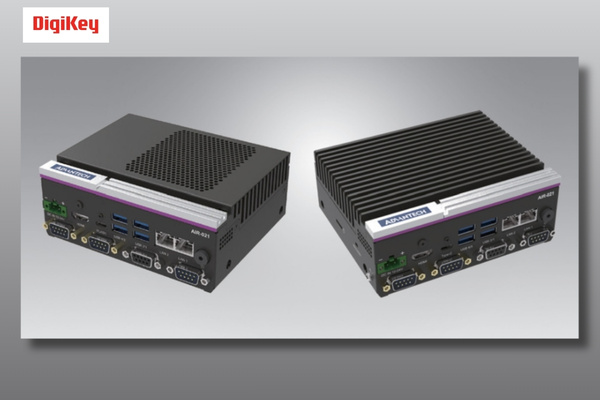
- Cooling method: The Orin NX 16GB configuration uses an internal fan and runs from -20°C to 50°C without added airflow, while the other two configurations are fanless, as Figure 1 shows.
A fanless design has no fan to wear out or fail. The heat still has to go somewhere.
Both fanless configurations reach 50°C only with 0.7 m/s airflow, and the Orin Nano configuration operates only down to -10°C. If the installation cannot provide that airflow, the fan-cooled model may be the safer choice.
Connecting inference results to the machine
The AIR-021 front panel, shown in Figure 2, connects the inference results to the machine. One CANBus port (1 Mbps, no CAN FD) serves motor controllers, and an 8-bit digital I/O port carries PLC signals.
The panel also has two RS-232/422/485 ports, one 2.5 GbE and one 1 GbE port, and four USB 3.2 Gen2 ports for USB industrial cameras. M.2 slots accept optional 5G and Wi-Fi modules. The interface set is identical on all three configurations.
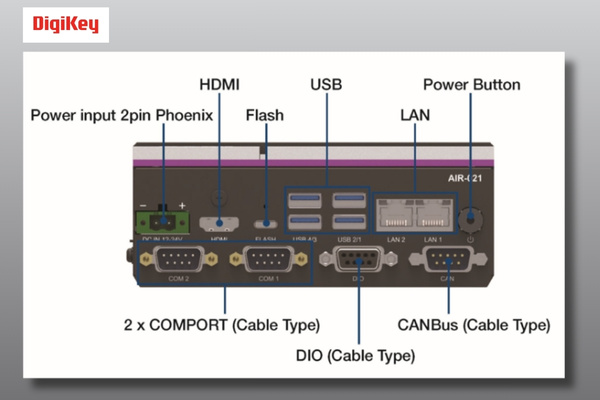
The Ethernet ports suit GigE cameras or a PLC link, and switches set each COM port to RS-232, RS-422, or RS-485.
Fitting into tight and moving installations
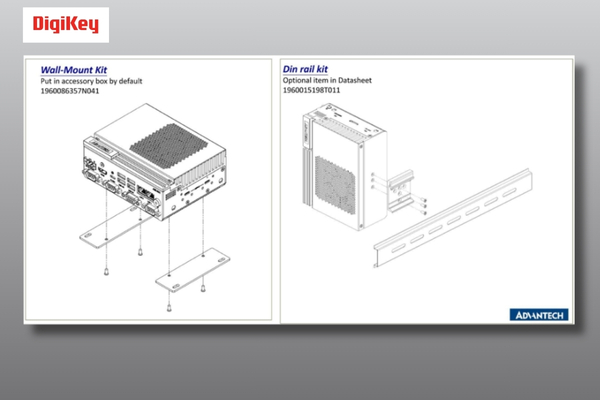
The AIR-021 measures 138 x 110 x 57 mm and weighs 1.2 kg. A wall mount kit ships in the box, and an optional DIN rail kit mounts the unit inside a control cabinet, as Figure 3 illustrates.
- Vibration and shock: With an M.2 SSD installed, the system is rated for 3 Grms random vibration from 5 Hz to 500 Hz per IEC 60068-2-64 for 1 hour on each of three axes. It is also rated for a 30 G half-sine shock of 11 ms per IEC 60068-2-27, applied three times to each of six faces. Engineers should compare these test levels with those of the robot or machine.
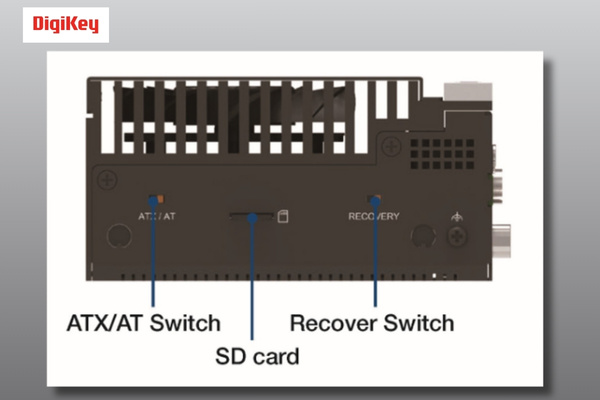
- Power on behavior: A side panel AT/ATX switch, as shown in Figure 4, sets how the system powers on. In AT mode, industrial PCs generally start when DC power is applied, which suits machines that power up from a main switch. ATX, the default, typically waits for a power button press.
- Certifications: The system carries CE, FCC Class B, CB, UL, CCC, and BSMI marks. It is not certified under the EU Radio Equipment Directive, so EU systems that add the optional Wi-Fi or 5G modules must show conformity for the final configuration.
Choosing an AIR-021 configuration
All three AIR-021 configurations share one platform. Each uses a 1024-core NVIDIA Ampere architecture GPU with 32 Tensor Cores, the same I/O and expansion, and a TPM 2.0 chip.
Each ships with a 128 GB NVMe M.2 2280 SSD preinstalled with Ubuntu 22.04 LTS and JetPack 6.2. The platform is compatible with the Advantech Edge AI SDK for deploying and validating AI models. The Jetson module, memory, CPU core count, and cooling vary across configurations.
AIR-021O-S0A1U, Orin NX 16 GB, 157 TOPS: This configuration sits at the high end of the range for applications such as running several models or camera streams simultaneously, in installations where a fan is acceptable. It pairs an 8-core Arm Cortex-A78AE CPU with 16 GB of LPDDR5 memory and delivers 157 TOPS in Super Mode at a 40 W TDP. Its fan-cooled design runs from -20°C to 50°C without added airflow and draws 13.36 W at OS idle and 46.92 W at full load.
AIR-021O-B0A1U, Orin NX 8 GB, 117 TOPS: This configuration brings Orin NX performance to mobile robots and machines with limited power that call for fanless operation. It combines a 6-core Arm Cortex-A78AE CPU with 8 GB of LPDDR5 memory, and it is rated at 117 TOPS in Super Mode, limited to 20 W TDP. Its fanless design operates from -20°C to 50°C with 0.7 m/s airflow and draws 12.35 W at OS idle and 25.19 W at full load.
AIR-021R-S7A1U, Orin Nano 8 GB, 67 TOPS: This configuration is the lowest-cost option for lighter AI workloads where cost matters most. It combines a 6-core Arm Cortex-A78AE CPU with 8 GB of LPDDR5 memory and delivers 67 TOPS in Super Mode at a 25 W TDP. It also drives HDMI at up to 3840 x 2160 at 30 Hz. Its fanless design operates from -10°C to 50°C with 0.7 m/s airflow and draws 12.93 W at OS idle and 31.6 W at full load.
Conclusion
Specifying edge AI compute for a machine means matching the workload to the available power, thermal envelope, ambient range, I/O, and installation. Peak TOPS shows only the best case. Measured system power, cooling, and temperature limits often decide the fit first.
The Advantech AIR-021 series makes that approach practical. Its three configurations keep the same I/O, mounting, and software, so the choice comes down to what the installation can supply in power and remove in heat. TOPS then becomes one input to the decision.