


Alibaba’s research arm, Damo Academy, has unveiled a next?generation RISC?V?based chip built to power AI agents and advanced cloud workloads. The new processor, called the XuanTie C950, is described as the most powerful CPU core in Alibaba’s XuanTie lineup and is positioned as a flagship engine for AI?agent?driven applications.
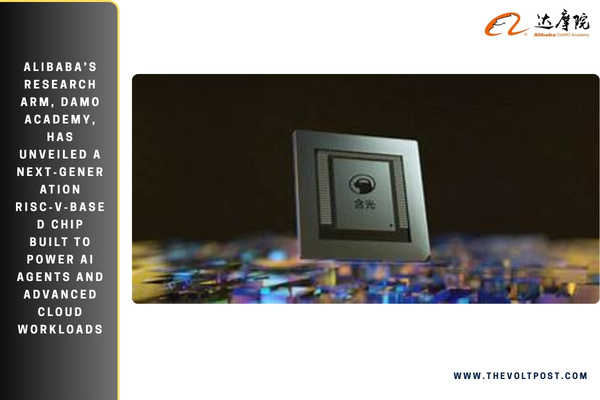
Based on the open?source RISC?V instruction?set architecture, the XuanTie C950 is designed for demanding cloud and AI tasks, including autonomous operations by AI agents programs that can independently carry out complex functions on behalf of users or services.
Alibaba claims the chip can deliver more than three times the performance of its earlier C920 core, which already targeted high?performance computing workloads.
The C950 features an 8?instruction decode width and a 16?stage pipeline, allowing it to process and execute a large number of instructions per cycle. This architecture is tuned for server?grade inference and agentic AI workloads, where both speed and throughput matter.
Because RISC?V is royalty?free, Alibaba can tailor the instruction set and optimize the core for specific AI and cloud tasks without the licensing costs that come with traditional CPU architectures.
The launch arrives as major Chinese tech companies, including Alibaba, Tencent, and ByteDance, push to build or integrate their own AI agents in the wake of the rapid spread of OpenAI?linked agent platforms.
Those agents rely heavily on underlying infrastructure, and Alibaba is positioning its in?house XuanTie chips as a way to gain performance control and supply?chain flexibility amid tightening global semiconductor constraints.
Alibaba has been a long?standing advocate of RISC?V in China, first introducing the XuanTie series back in 2018. The C950 builds on that trajectory, feeding into Alibaba Cloud’s broader strategy of deploying custom silicon for AI training, inference, and data?heavy services.
Instead of selling the chips as standalone products, the company is focusing on differentiating its AI and cloud offerings through its own silicon stack.
 For the semiconductor industry, the move signals how RISC?V is moving beyond embedded and niche applications into high?performance server and AI inference roles. If Alibaba can turn the C950’s performance claims into large?scale deployments, it could reshape how AI?agent infrastructures are designed not just in China, but also in global markets.
To Know More: CLICK HERE