



As automakers rush to make driver and occupant monitoring a standard feature across their lineups, they face a familiar bottleneck – balancing high-end camera performance with strict system cost limits. STMicroelectronics is targeting exactly that friction point with the ST SafeSense VD56GA, a new 1.1-megapixel automotive image sensor designed to make infrared in-cabin sensing cheaper and easier to integrate.
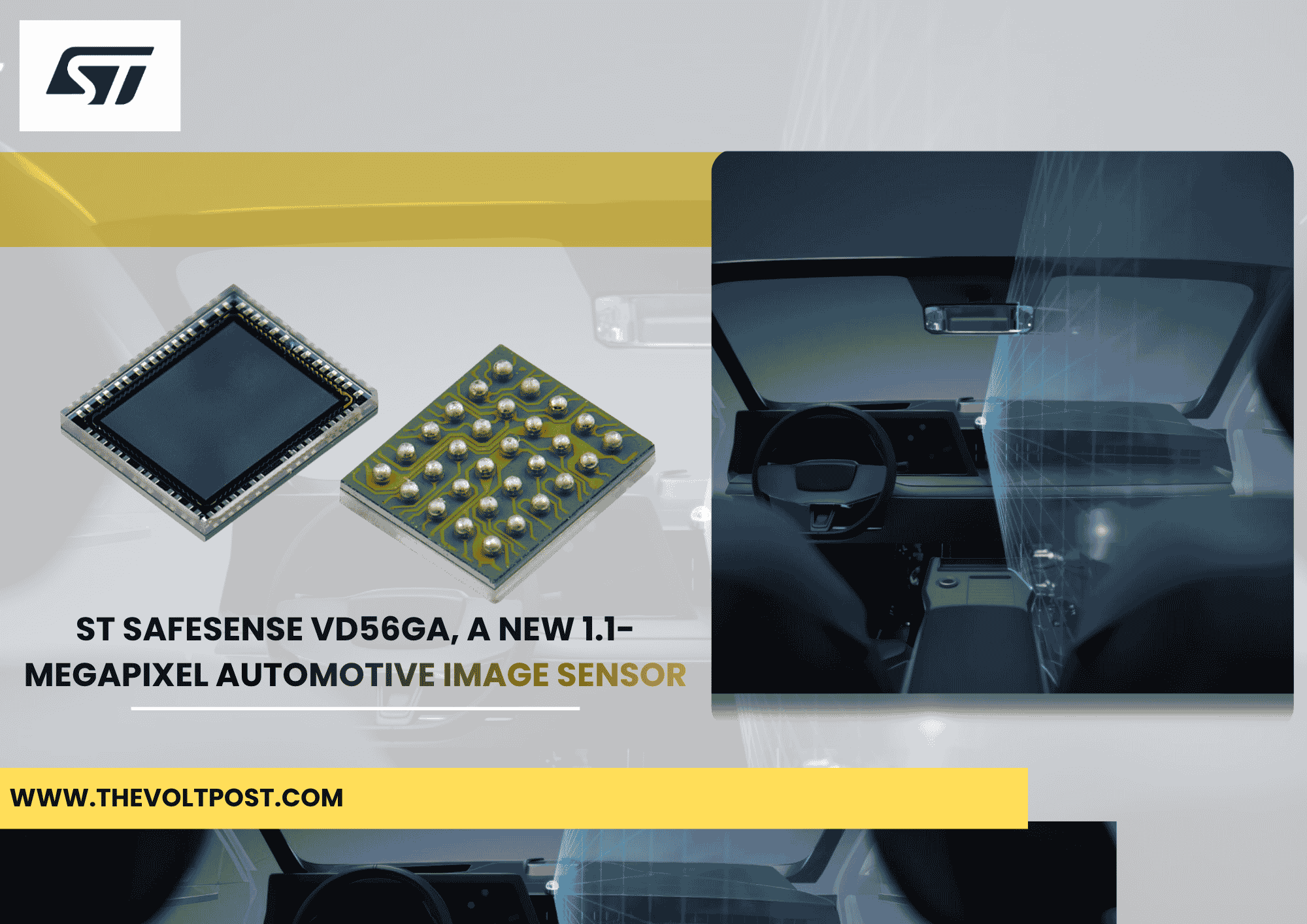
The core advantage of the ST SafeSense VD56GA is its ability to extract premium image quality from a highly compact 1.1 MP architecture. The sensor is built on ST DeepNIR, a new backside-illuminated pixel architecture optimized specifically for infrared imaging.
This setup delivers 35% higher modulation transfer function (MTF) sharpness and a nearly 60% boost in quantum efficiency compared to the previous generation. For engineering teams, this class-leading mix of optical resolution and IR sensitivity makes it much easier to deploy monitoring systems in challenging environments, such as under-display cameras.
For OEMs and Tier 1 suppliers, the real story is module-level cost reduction. Because the VD56GA performs so efficiently, designers can hit their performance targets using lower-cost optics, simpler infrared illumination, and less demanding optical filters.
It also eliminates the need for external image processing. Housed in a tiny 3.7 mm by 3.2 mm CSP package suitable for tight cabin spaces, the sensor comes with built-in processing capabilities including mirror, crop, dark calibration, auto-exposure, and piecewise-linear processing.
By offering both RAW and YUV output formats, ST provides developers the flexibility to drop the sensor into a wide variety of software environments and electronic architectures without a heavy redesign lift.
The rollout of the ST SafeSense VD56GA follows a major milestone for STMicroelectronics, which shipped its 10 millionth SafeSense automotive image sensor earlier this year across US, European, and Asian markets.
To ensure supply continuity, ST is maintaining a vertically integrated manufacturing model for the new sensor, running front-end fabrication at its facility in Crolles, France, and handling packaging in Asia.
Leadership Comments
“In-cabin sensing is moving beyond premium platforms, and carmakers need cost-effective solutions they can deploy broadly,” said Alexandre Balmefrezol, Executive Vice President and General Manager of the Imaging Sub-Group at STMicroelectronics.  “With VD56GA, we focused on the system-level tradeoffs that matter most: image quality in infrared conditions, compact integration, and a cost structure that supports high-volume programs. Equally important, the sensor benefits from ST’s Integrated Device Manufacturer model, with front-end manufacturing in Crolles, France, giving customers greater supply-chain resilience, quality control, and long-term support for automotive programs.”
“As driver and occupant monitoring systems move into a broader range of vehicle platforms, OEMs are increasingly focused on solutions that can be deployed at scale, with volumes set to exceed 70 million units by 2031. Success in this market depends not only on imaging performance, but also on reducing system cost, simplifying integration, and enabling adoption across high-volume vehicle programs,” (*) underlined Anas Chalak, Market & Technology Analyst, Imaging at Yole Group.
Availability
Samples are available now. Pricing information and sample requests are available from local ST sales offices.
Learn more: https://www.st.com/en/imaging-and-photonics-solutions/vd56ga.html