





 Just a few years ago, most applications using artificial intelligence were based on a simple operating scheme. Data from sensors went to a server or cloud, where it was analyzed by an AI model, and then the result returned to the device. This solution worked well in many applications, but it also had its limitations—it required a constant network connection, generated delays, and involved the need to transmit large amounts of data.
Today, the situation looks completely different.
The development of more efficient microcontrollers, energy-efficient embedded systems, and machine learning models optimized for edge devices has made it possible for data processing to be carried out locally, directly where the input data is generated.
This is the basis of the Edge AI concept.
Instead of sending all the information to an external server, the intelligent device analyzes the data independently and reacts to it immediately. In many applications, this means a shorter response time, greater reliability, and the ability to operate even when an internet connection is unavailable.
INTELLIGENCE DOESN’T ALWAYS MEAN THE CLOUD
Imagine an air quality sensor working in a production hall.
Its task is to monitor the concentration of dust and volatile chemical compounds. If it detects an exceedance of the set level, it should immediately activate the ventilation system and notify the operator.
Until recently, the typical scenario looked like this:
sensor ? cloud ? AI model ? decision ? device.
Each measurement had to be sent to an external system, where analysis took place. Only after it was completed did the device receive information about further action.
Today, the same process often proceeds quite differently.
The AI model operates directly on the device. Data does not leave the local network, and the decision is made immediately after the measurement is taken.
This approach is finding applications not only in industry. It is increasingly encountered in smart buildings, IoT devices, environmental monitoring systems, and modern consumer electronics.
WHAT EXACTLY IS A LOCAL AI AGENT?
Although the term AI Agent is currently gaining huge popularity, in the context of embedded devices it means something much simpler than the multi-stage systems known from generative artificial intelligence applications.
It can be treated as a program that can independently observe the environment, analyze incoming data, and make decisions according to a specified goal.
The most important thing is that the entire process takes place locally.
The agent does not need to send every measurement to the server or wait for a response from the cloud. It interprets the information from the sensors, assesses the situation, and performs the appropriate action according to a specified algorithm.
Depending on the application, this may be:
- activating ventilation,
- detecting unusual machine behavior,
- changing the parameters of the device’s operation,
- sending a notification to the operator,
- recording the event in the supervisory system.
This ability to make decisions independently is why we increasingly talk about intelligent agents operating directly on end devices.
**How does a local AI agent work?
Although local AI agents can perform very different tasks, the principle of their operation remains similar. The device receives data from the environment, analyzes it using a machine learning model, makes a decision, and—if necessary—carries out a specific action.
In practice, this process can be presented in several steps:
- Reading data from sensors or other sources.
- Preliminary data processing.
- Analysis using the AI model.
- Making a decision.
- Carrying out the appropriate action or passing information to the supervisory system.
Unlike classic cloud-based solutions, the entire process takes place locally. This means that the device does not have to wait for a response from the server, allowing it to react almost immediately.
WHY IS EDGE AI GAINING IMPORTANCE?
The ability to make decisions locally brings a number of benefits that are significant both in industrial applications and IoT projects.
The most important of these are:
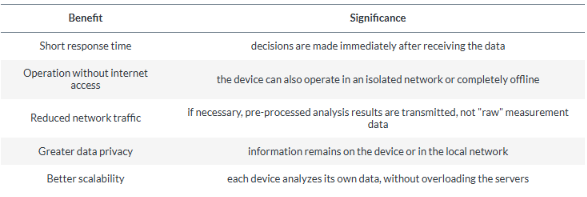
This does not mean, of course, that cloud solutions are losing importance. In many applications, they remain the best choice, especially when it is necessary to analyze very large data sets or train machine learning models. However, the decision-making process is increasingly being moved directly to end devices.
WHERE CAN LOCAL AI AGENTS BE USED?
Although the term “AI Agent” is most often associated with generative artificial intelligence applications, a similar concept is also applicable in electronics and automation.
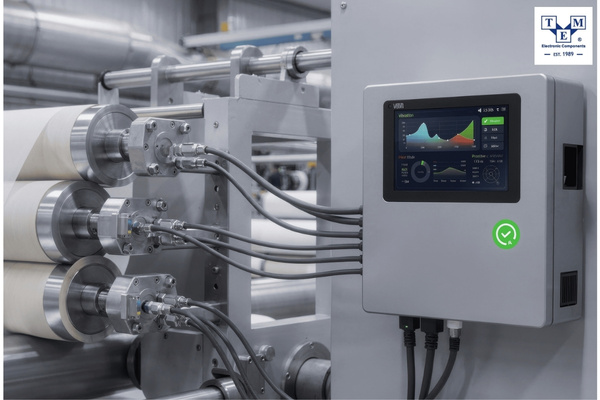
Local AI agents can support, among others:
- machine condition monitoring and anomaly detection,
- image analysis in AI Vision Inspection systems,
- controlling IoT devices,
- intelligent energy management systems,
- environmental monitoring,
- building automation,
- robotics and autonomous devices.
In each of these applications, the agent does not replace the entire control system. It is responsible for data analysis and making a decision regarding a specific task, and then passes the result to the operator or cooperating devices.
FROM A SINGLE DEVICE TO AN INTELLIGENT ECOSYSTEM
One of the biggest advantages of Edge AI is the possibility of gradually expanding the project.
The first step might be a single sensor analyzing data locally. Over time, more devices can be added to the system, each independently performing its own tasks while also cooperating with the supervisory system.
This approach allows for the construction of distributed systems, where each unit is responsible for analyzing its own data. This keeps the solution scalable, and expanding the infrastructure does not require centralization of the entire computational process.
ARDUINO UNO Q AS A PLATFORM FOR EDGE AI APPLICATIONS
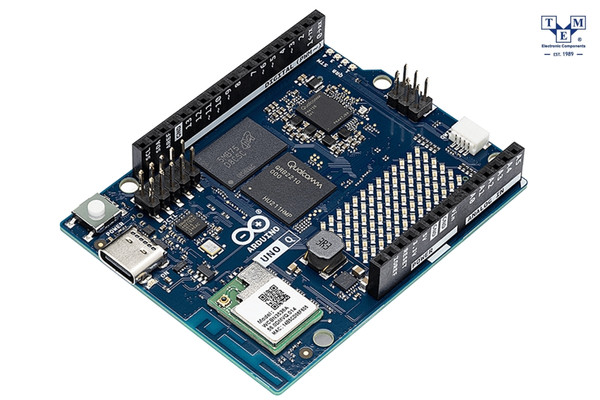
The development of local AI agents would not be possible without suitable hardware platforms. A device working at the edge of the network must not only communicate with sensors and other system elements but also have sufficient computational power to perform machine learning models while maintaining low energy consumption.
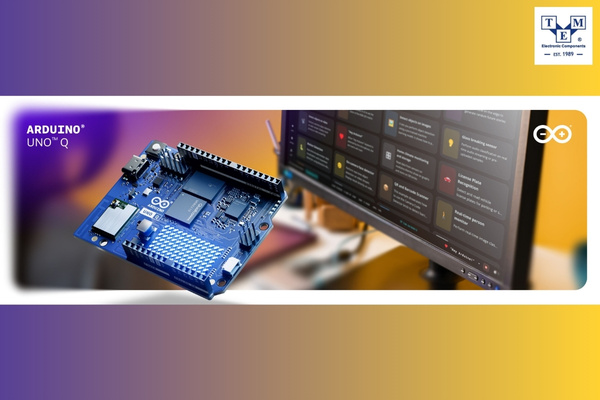
With this in mind, Arduino has prepared the UNO Q platform. In the campaign “Discover practical applications of Edge AI with Arduino UNO Q,” the manufacturer shows that many applications using artificial intelligence can be implemented locally—without the need to transmit all data to the cloud.
Thus, the UNO Q can serve as an intelligent node analyzing information from sensors, cameras, or other devices, and then making decisions and passing only the results to the supervisory system.
This approach works perfectly during the construction of demonstrators, Proof of Concept projects, and initial implementations using Edge AI.
WHAT DOES A TYPICAL SOLUTION ARCHITECTURE LOOK LIKE?
Although the specific configuration depends on the type of application, the operation scheme of a local AI agent remains very similar.
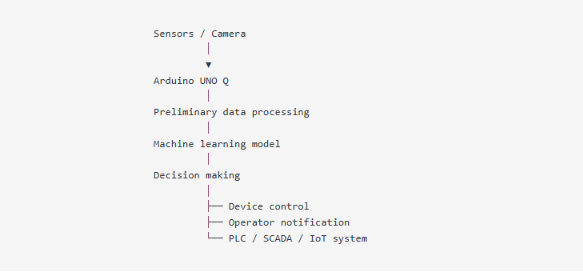
This architecture allows for the separation of data analysis from the supervisory system. The device performs calculations locally, and only the information needed for further action is passed to the other infrastructure components.
WHERE TO START?
Just like with machine condition monitoring or AI Vision Inspection systems, here too the best solution is to start with a small pilot project.
A good starting point might be a device that already performs simple measurements or controls a specific process.
Adding local data analysis allows you to gradually expand its capabilities without the need to rebuild the entire infrastructure.
A typical work plan might look like this:
- Define the problem that the device is to solve.
- Select the appropriate sensors or data sources.
- Prepare and test the AI model.
- Integrate the model with the embedded platform.
- Tests in real working conditions.
- Expand the solution with additional functions or devices.
This approach helps to minimize project risk while gaining the experience needed during the construction of more complex applications.
WHAT COMPONENTS WILL BE NEEDED?
The Arduino UNO Q platform is the central element of the solution, but the effectiveness of the entire system depends on the appropriate selection of other components.
Depending on the type of project, these may include:
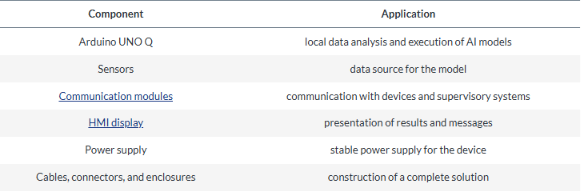
Thanks to TME’s wide range, all the elements needed to build a demonstrator or first prototype can be assembled in one place, and then the project can be developed as new requirements arise.
CHECK THE TME CATALOG
SUMMARY
Just a few years ago, artificial intelligence was primarily associated with powerful servers and cloud-based services. Today, more and more models can work directly on embedded devices, analyzing data locally and making decisions in real time.
This does not mean that cloud solutions are no longer needed. In many applications, they remain an essential part of the entire infrastructure. However, intelligence is increasingly moving closer to devices—where data is generated and where quick response matters.
Platforms such as Arduino UNO Q show that building applications using Edge AI does not have to mean a complicated project or large investment costs. Starting with a small demonstrator allows you to verify assumptions, gain practical experience, and gradually develop the solution as user needs evolve.
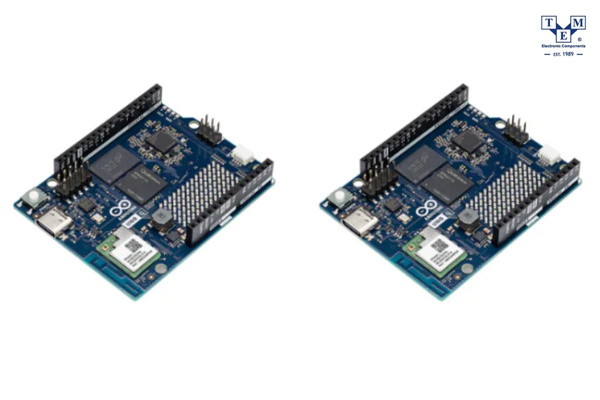
DISCOVER MORE APPLICATIONS OF ARDUINO UNO Q
Local AI agents are just one example of the use of the Arduino UNO Q platform. See also how to use it for:
Condition Monitoring and machine vibration monitoring,
AI Vision Inspection and automatic quality control.
Go to the page “Discover practical applications of Edge AI with Arduino UNO Q”
 Transfer Multisort Elektronik (TME) is one of the world’s largest global distributors of electronic components, electrotechnical parts, workshop equipment, and industrial automation. The catalog includes over 1,500,000 products from 1,300 leading manufacturers. TME’s modern logistics centers in ?ód? and Rzgów (Poland), with a combined area of over 40,000?m², ship nearly 6,000 packages daily to customers in more than 150 countries.
TME also invests in the development of knowledge and skills of young engineers and electronics enthusiasts through the TME Education project, and supports the tech community by organizing the TechMasterEvent series, promoting innovation and experience exchange.
 ARTICLE SOURCE: TME