




GE Aerospace has marked a major milestone in the push toward more electric flight, successfully demonstrating the aviation industry’s first hybrid electric flight above 30,000 feet. The test, carried out with NASA, BETA Technologies and Boeing, is part of a broader effort to prove that hybrid electric propulsion can work at commercial aircraft altitudes and not just in lab conditions.
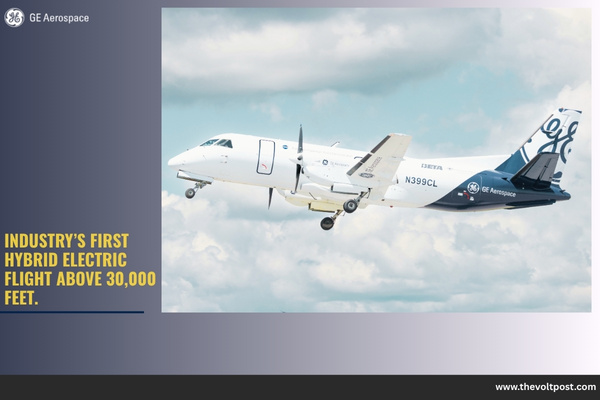
The breakthrough flight was conducted on a modified Saab 340B test aircraft powered in part by GE Aerospace’s integrated megawatt-class hybrid electric propulsion system.
During the campaign, the aircraft logged its longest hybrid electric flight at more than two hours, showing the system’s potential for future aviation platforms.
GE Aerospace said the milestone builds on years of development under NASA’s Electrified Powertrain Flight Demonstration project. The system combines motor/generators, power converters, inverters, controllers, gearboxes, propellers, heat exchangers, torque sensing, engine harnesses and a CT7 engine, all packaged into an inverted nacelle designed to improve ventilation.
H. Lawrence Culp, Jr., Chairman and CEO of GE Aerospace, called the achievement “one for the history books,” saying the company is grateful for the collaboration with NASA, BETA Technologies and Boeing as it works to advance hybrid electric technology for greater efficiency, durability and range.
The aircraft’s journey to Farnborough was itself part of the demonstration. GE Aerospace pilots and BETA Technologies pilots supported the test flights in the U.S., while BETA served as systems integrator and ferried the aircraft to the UK in hybrid electric mode for each leg of the trip.
The company is also using the event to highlight the wider promise of hybrid electric propulsion. By combining an electric powertrain with a traditional gas turbine, the architecture can improve power management across different flight phases, support multiple fuel types and fit into advanced engine designs such as Open Fan.
GE Aerospace says the technology has been shaped by a decade of testing and validation, including an electric motor-driven propeller test in 2016, a 2022 altitude test up to 45,000 feet, a 2025 partnership and investment with BETA Technologies, and a narrowbody hybrid electric demonstration through NASA’s HyTEC project.
All of this feeds into the broader CFM International RISE program, which has now completed hundreds of test campaigns and is targeting more than 20% better fuel burn than today’s commercial engines. The company says the long-term goal is to make hybrid electric systems a practical path for next-generation aviation.
Leadership Comment
 Kyle Clark, Founder and CEO of BETA, said, “This hybrid electric system improved the high-altitude performance and climb capability while creating a flying laboratory to inform all future hybrid designs. The GE Aerospace team brought rigorous design, test and operational expertise. The ground and safe flight test campaigns, capped by a flight across the North Atlantic, is the first of many important milestones for hybrid electric technology.”
Graham Drozeski, CTO of Aurora Flight Sciences, a Boeing company, said: “This team delivered multiple first-of-a-kind advancements to successfully integrate a high-voltage electrified propulsion system into an aircraft operating at commercial altitudes. Together, we’ve taken a significant step forward in hybrid-electric technology.
Mohamed Ali, President and CEO, GE Aerospace Commercial Engines & Services, said, “Hybrid electric technologies are durable and efficient. By flying a hybrid electric engine system at altitudes never achieved before, we’re proving to our customers and to the industry the advanced capabilities we can bring to next-generation aircraft with ready technologies.”
To Know More: CLICK HERE