



Infineon Technologies has expanded its automotive radar lineup with the RASIC CTRX8144FS, a new 76-81 GHz monolithic microwave integrated circuit (MMIC) designed specifically for centralized vehicle architectures and software-defined platforms.
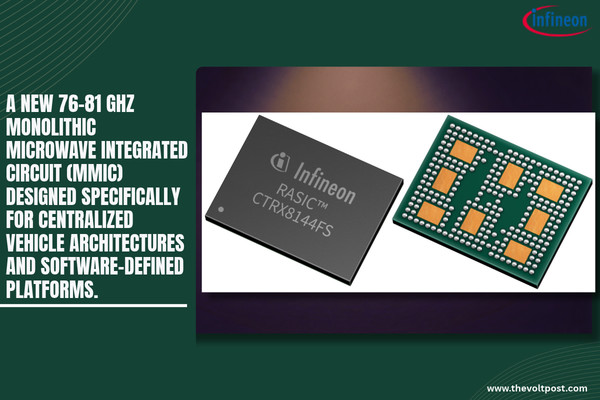
Building on the existing CTRX8191F/FS and CTRX8188F devices, the new 4-transmit, 4-receive (4Tx/4Rx) transceiver targets corner and front radar modules in advanced driver assistance systems (ADAS).
As automakers shift away from distributed smart sensors toward centralized computing, corner radar plays a critical role in navigating complex scenarios like lane merges, cross-traffic alerts, roundabouts, and skewed intersections, regardless of lighting or weather conditions.
Rather than processing data at the edge, the CTRX8144FS is engineered to stream raw radar data straight to a central compute unit via an integrated CSI-2 interface running at up to 1.2 Gbps per lane. Stripping out the need for extra companion processors simplifies sensor module design and trims down the bill of materials.
Key Technical Highlights:
- High-Resolution Sensing: Supports bandwidths up to 4 GHz paired with fast ramp slopes of up to 200 MHz/µs for rapid object detection and tracking.
- Streamlined RF & Board Design: Integrated radio-frequency (RF) waveguide ports eliminate tricky high-frequency transitions on the PCB, cutting signal loss while lowering overall thermal resistance.
- High Integration: Combines a digital PLL, flexible sequencer, integrated power management, and low-dropout regulators (LDOs) to keep external component counts low.
- Automotive Safety & Diagnostics: Qualified to AEC-Q100 Grade 1 and developed as an ISO 26262 Safety Element out of Context (SEooC) up to ASIL B. Built-in diagnostics continuously track internal temperatures and RF performance across extreme operating ranges.
Leadership Comment
 “Centralized processing shifts signal processing from the radar sensor to a central ADAS compute unit,” said Andreas Kopetz, Head of the Radar Product Line at Infineon. “By removing memory and computing constraints at sensor level, the architecture enables larger radar data sets and more advanced algorithms. This can support improvements in detection range, sensitivity and target separation. The resulting high-quality radar data provides a strong foundation for AI- and machine-learning-based sensor fusion.”
Availability
The product is now available.
To Know More: CLICK HERE