





Imagine a world where your country’s most sensitive data like health records, financial transactions, defense strategies sit on servers controlled by foreign companies halfway across the globe.
What if those companies had to hand it over under a different country’s laws? That’s the vulnerability digital sovereignty aims to fix.
At its core, digital sovereignty is a nation’s ability to control its own digital destiny. For example its data, infrastructure, software, and tech standards, without undue reliance on outsiders.
It’s not about shutting out the world; it’s about having the power to decide who accesses what, where data lies, and how technology serves national interests.
For individuals, it means real control over personal info. For businesses, it’s avoiding vendor lock-in. But for countries like India, it’s a strategic imperative in an era where data is the new oil and geopolitics can flip the switch anytime.
Breaking Down Digital Sovereignty
Think of it as extending traditional sovereignty into the digital realm. States want jurisdiction over data flows, hardware like semiconductors, and software that runs everything from UPI to Aadhaar.
Europe pushes it through GDPR and GAIA-X clouds; China with its Great Firewall and homegrown tech giants. Here India is carving a unique path, blending openness with self-reliance.
Key pillars include:
- Data sovereignty: Where data is stored (localization) and who can touch it.
- Technological sovereignty: Building indigenous chips, AI, and OS to cut foreign dependencies.
- Regulatory sovereignty: Enforcing homegrown rules on global platforms without pushback.?
In simple terms, it’s ensuring your digital house follows your rules, not someone else’s.
Why It’s Suddenly Urgent Worldwide
US-China tech wars showed how sanctions can choke supply chains emember Huawei bans. Cyberattacks from state actors exploit foreign-hosted data.
And privacy scandals like Cambridge Analytica highlighted how unchecked Big Tech can sway elections or economies.
Benefits are clear: better cybersecurity, compliance with local laws, economic boosts from homegrown innovation, and cultural alignment (think supporting regional languages in AI).
Without it, nations risk becoming “digital colonies,” generating value for others while losing control.
India’s Digital Journey: From Stack to Digital Sovereignty
With 900 million+ internet users, it’s a digital superpower but heavily reliant on foreign clouds (AWS, Azure), chips (mostly imported), and apps.
Enter India’s “digital public infrastructure” (DPI): Aadhaar (world’s largest biometrics ID), UPI (revolutionized payments, now exported to 20+ countries), and ONDC (open e-commerce network). These “digital public goods” cut foreign dependence, empowered billions, and inspired nations like Brazil.
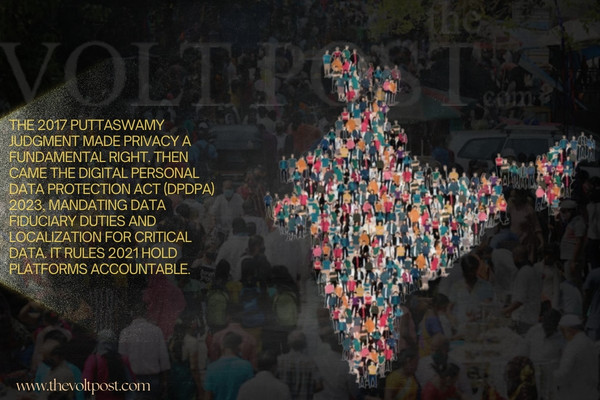
The 2017 Puttaswamy judgment made privacy a fundamental right. Then came the Digital Personal Data Protection Act (DPDPA) 2023, mandating data fiduciary duties and localization for critical data. IT Rules 2021 hold platforms accountable.
Semicon missions pump billions into domestic fabs. Even the India-UK FTA eyes digital clauses protecting sovereignty.
These aren’t just policies; they’re proof of concept. UPI processes more transactions than Visa globally, without Big Tech middlemen.
Why Digital Sovereignty Is a Must for India Right Now
India’s stakes are sky-high. Security first: Foreign servers mean espionage risks—imagine defense data routed through the US or China. Cyber threats hit India hard; sovereignty localizes vulnerabilities.
Economic muscle: Tech giants extract trillions in value from Indian data while employing few locals. Sovereignty fosters startups, jobs in AI/chips (India aims for 1 million by 2030), and reduces $100B+ annual import bills.
Democratic safeguard: Algorithms shape discourse, platforms must answer to Indian laws, not Silicon Valley. During elections, traceability rules prevent misinformation without full censorship.
Global edge: As G20 chair (rotating), India pushes “open, democratic” models abroad, contrasting China’s firewall. DPI exports position India as a leader for the Global South.
Privacy imperative: With DPDPA, citizens get “right to be forgotten” and erasure vital as data breaches soar.
Without it, India risks geopolitical leverage (e.g., trade wars blocking apps) or economic drain. With it, a $1T digital economy by 2028 can be foreseen while becoming self-reliant and innovative.
 Hurdles With Opportunities
India currently imports 90% of its chips. No homegrown OS rivals for Android. Building fabs takes billions Tata’s Gujarat plant is a start, but scaling lags.
Strict localization hikes costs for SMEs; overreach could scare FDI. Privacy vs. surveillance tensions persist, independent oversight is key.
India needs millions skilled in AI, cyber, chips. Focusing on global norms, India must advocate in WTO/G20 against “digital colonialism.”
Migrating from foreign clouds is tough, hence sovereign clouds shall become pivotal.
Why Acceleration Now Is Important For India
- Invest big: Semicon incentives, indigenous AI (like Bhashini for languages).
- Diversify: Multi-vendor policies, open standards.
- Upskill: National programs for 10M digital jobs.
- Global push: Export DPI, shape rules via BRICS/G20.
Digital sovereignty isn’t isolation, it’s empowerment. For India, the world’s most populous nation and fastest-growing major economy, it’s about turning digital scale into strategic strength.

