





Continental has achieved a significant milestone, having produced 200 million radar sensors. This tremendous quantity of radars manufactured underscores the company’s market leadership position, with more than 20% market share in critical safety technology components for the automotive industry.

It also emphasizes a significant mobility trend: the rapid development of advanced driver assistance systems (ADAS) for automated and future autonomous driving. From 1999, when the first version of Continental’s long-range radar was fitted into the Mercedes S-Class, to 2021, the company supplied 100 million radar systems.
Four years later, a new milestone was met: 200 million radar sensors. This rapid rate of development reflects substantial technology advances in development and performance, as well as demand for car safety features.
Furthermore, the technology company revealed that it got substantial series orders for radar sensors from various vehicle manufacturers totaling approximately €1.5 billion in the first quarter of the year. Production starts are scheduled for 2026 and 2027, depending on the manufacturer.
Greater comfort and safety: radar sensors are essential in driver assistance systems
The quick increase in sales is attributed to the increasing number of radar sensors in modern automobiles. Radar sensor technology in advanced driver assistance systems enhances vehicle and road safety and comfort.
Continental has an extensive array of strong radar systems that are tailored to each application and market requirement. Previously, a single radar sensor for regulating distance was mounted at the front of a vehicle; however, nine or more radar sensors are now employed in some cases.
Aside from the “classic” adaptive cruise control, assistance systems for emergency braking, blind spot detection, lane departure warning, cross-traffic alerts, and parking all require radar support, usually in conjunction with other sensors such as cameras, ultrasonic, and LiDAR systems.
Radar systems are particularly essential for highly automated or driverless cars, which require precise and redundant 360-degree vehicle environment monitoring.
Radar revolution: from a pioneering product to high-tech components with a microchip
The radar technology used in vehicles has undergone a dramatic metamorphosis in the previous few years. Continental was instrumental in the development of the world’s first radar system for automobiles: in 1999, Daimler introduced adaptive cruise control in its S-Class. This system was the first to use a long-range radar with a range of 150 meters, which was unprecedented at the time.
The system was limited and, when compared to modern systems, quite massive and heavy. It comprised of two parts: a radar head mounted behind the radiator grille and a control unit. The two components weighed 1.3 kilograms and were about the size of a shoebox.
However, even back then, Mercedes and Continental preferred this complex technology. Radar sensors, unlike infrared sensors, perform regardless of light or visibility conditions, including fog and darkness.
Today’s radar systems no longer have much in common with the first generation. “Smart radar sensors, for example, are already equipped with powerful microchips, which directly process the signals received from the sensor and – usually in combination with data from other sensor systems such as cameras – make it available in real time,” explains Norbert Hammerschmidt, head of Components Business in the Autonomous Mobility business area. Continental leads the way in the development of highly efficient radar systems, which today cost only a fraction of the first pioneering system and require very little space – the size of two matchboxes.
The most recent radar sensors are employed either for short-range operations, such as parking assistance systems or lane departure warning systems on highways, or for classic long-range operation with ranges of up to 300 meters.
Furthermore, contemporary systems are so exact that they can clearly distinguish objects at considerable distances in conditions where the human eye cannot. For example, when changing lanes on a highway, they can identify a motorcycle approaching from behind at a high speed or partially disguised pedestrians in urban traffic scenarios.
Platform approach: radar sensors for use in passenger cars, trucks, and two-wheelers
Continental currently develops and trains these systems utilizing artificial intelligence for every application and market, including highly automated premium vehicles, mass-produced passenger car models, semi-autonomous trucks, and the worldwide two-wheeler industry. In doing so, Continental provides a portfolio that is ideally tailored to the demands of clients worldwide.
This includes premium versions like the new, high-performance 4D long-range imaging radar, which will replace the previous generation next year and will be capable of enabling fully autonomous vehicle systems.
However, the majority of output is comprised of mass-produced versions like as front and corner radars, which provide great performance at a low cost for a wide range of purposes.
Leadership Comments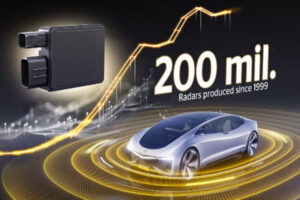
“The mark of 200 million radar sensors produced – and the major series orders – emphasize that Continental stands for high-tech engineering, pioneering spirit, and customized technology solutions for every application in the automotive market,” said Ismail Dagli, head of the Autonomous Mobility business area at Continental. “Radar sensors are a key component for the mobility of today and tomorrow. Without a differentiated portfolio of various radar systems, such as those from Continental, autonomous driving would not be possible.”

