



Hybrid tungsten oxyselenide/graphene electrodes that enable nearly lossless optical phase modulation in two-dimensional semiconductor devices have been developed by researchers from Nanyang Technological University, the University of Chicago, the University of Wisconsin, Chungnam National University, the National Institute for Materials Science, MIT, and Singapore University of Technology and Design.
The work focuses on a long-standing trade-off in integrated photonics, where increasing modulation efficiency usually results in an increase in optical loss, particularly for devices based on graphene at telecommunication wavelengths.
This method uses UV-ozone treatment to transform monolayer WSe? into tungsten oxyselenide (TOS), a potent p-type dopant for graphene.
Graphene can serve as a transparent, low-resistance top electrode in the near-infrared thanks to heavy p-doping, which lowers the material’s Fermi level so that its absorption around 1550 nm is significantly decreased while its conductivity is increased.
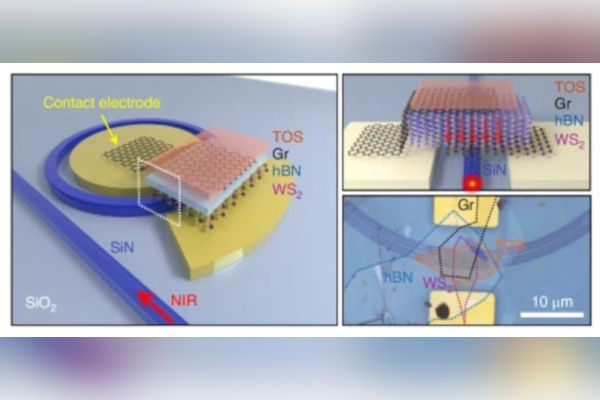
A monolayer WS? electro-optic layer, a hexagonal boron nitride (hBN) dielectric spacer, and a hybrid TOS/graphene transparent electrode are stacked on a silicon nitride (SiN) microring platform to construct the entire phase modulator.
This heterostructure provides effective phase modulation under a vertical electric field without experiencing parasitic absorption from the electrode while maintaining telecom-band transparency and strong electro-optic tuning via the WS?.
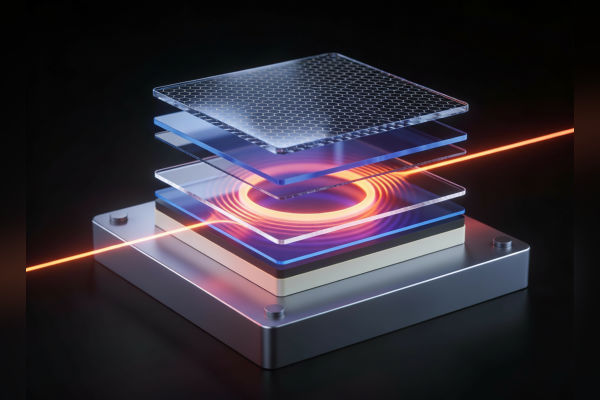 In comparison to similar devices using pristine graphene or indium tin oxide (ITO) electrodes under similar bias circumstances, the device achieved a modulation efficiency of 0.202 V·cm in experiments with an extinction ratio fluctuation of only 0.08 dB.
The findings demonstrate that the electrode may efficiently decouple phase modulation from intensity modulation by causing significant phase shifts in the microring resonance while maintaining transmission.
The architecture shows a feasible path to near-lossless, 2D-material-based phase modulators compatible with silicon nitride photonic systems by fusing the high carrier mobility of graphene with the customized band structure and doping effect of TOS.
Low insertion loss and accurate phase control are essential for quantum photonic circuits, integrated photonic computer components, and more energy-efficient optical interconnects.