





A novel battery packing system with an unparalleled energy density has been developed by 24M Technologies, a pioneering technological company that is revolutionizing battery design and manufacturing. This method can enhance the driving range of electric vehicles by up to 50%.
The revolutionary technology, known as 24M ETOP Battery Technology (Electrode-to-Pack), significantly increases packaging efficiency by sealing electrodes in thin polymer sheets that are then integrated straight into the pack.
Currently, lithium-ion batteries contain a significant amount of inactive, non-energy-carrying elements, such as supporting metals and plastics, within a cell’s case, increasing expense and squandering space. This is because battery and auto manufacturers build modules and packs from individual cells.
This approach is replaced by 24M ETOP battery technology, which creates a sealed cathode/anode pair, removing the cell, module, and unnecessary materials.
Because electrodes, the energy-storing components, make up a larger part of the battery, manufacturers are able to obtain the highest energy density for any chemistry (NMC, LFP, NCA, Sodium-ion, LTO, LiS, etc.) available at the pack level.
As opposed to the 30% to 60% of conventional battery packs, 24M ETOP battery technology actually allows electrodes to make up 80% of a pack’s volume.
Crucially, this innovation also gives car makers a new choice: lower EV prices by utilizing less expensive chemistries or give customers longer EV ranges by putting more energy into a pack of the same size.
For example, using the same chemistry, a 75kWh NMC (Nickel Manganese Cobalt) battery with 24M ETOP Battery Technology—the size and kind seen in many mid-sized electric vehicles—could be increased to over 100kWh, boosting range by 33% in the same-sized pack.
With 24M ETOP Battery Technology, NMC chemistry can be replaced with less expensive LFP (lithium-iron phosphate) technology, producing a pack that is less expensive while maintaining the same overall range.
Additionally, 24M ETOP provides unprecedented design versatility, allowing battery packs to be fully customized in almost any shape and with a variety of voltages.
OEMs and designers are free to produce ovals, hexagons, or any other shape that best fits the given area. Higher performance and cheaper expenses are the results of this pack efficiency. There are also significant advantages for production.
Individually sealed electrodes eliminate the requirement for conventional high tolerance and precision equipment, improving yield and safety while lowering investment costs by allowing electrode safety tolerances to be less stringent than in a conventional battery.
Battery designers have more options because the sealed electrodes may be flipped and connected in both series and parallel configurations. This allows for the creation of anything from a small 48V battery to a mixed series/parallel 400-800V pack.
Additionally, 24M ETOP battery technology makes it possible to form cells in series, which can reduce the cost of formation equipment, one of the largest CAPEX items in lithium-ion battery manufacturers today.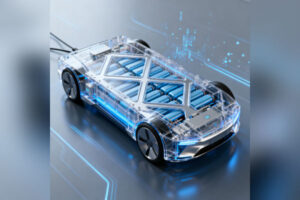
LEADERSHIP COMMENT
Naoki Ota, President and CEO at 24M Technologies said: “Minimising packaging materials and wasted space, 24M ETOP battery technology brings a step change in performance, replacing traditional cell-to-module-to-pack construction with electrode-to-pack construction, maximising energy density. 24M ETOP makes it easier to build compact, flexible and safe high voltage batteries, presenting a revolutionary opportunity for electric vehicle manufacturers – longer ranges with the same chemistry or the same range with lower cost, safer chemistries, both in the same space. It truly is the closest version of an ideal battery – it is essentially all active material in a sophisticated wrapper.”
24M ETOP Battery Technology can also be used with 24M’s Impervio separator, Eternalyte electrolyte, and its LiForever electrode, all of which are aimed at creating a fundamentally safer, higher performing and longer-lived battery through the reimagination of internal battery design.

