





Wireless Local Area Networks (WLAN) have become the backbone of modern connectivity, enabling everything from home streaming to mission-critical industrial operations. In 2025, WLAN technology is undergoing a rapid transformation, driven by the rise of high-bandwidth applications, emerging wireless standards, and the need for ultra-reliable connections, so here we underline the key trends shaping WLAN trends in 2025.
While innovation is unlocking new possibilities, network operators, enterprises, and consumers are also facing a fresh set of challenges in delivering fast, secure, and seamless wireless experiences.
Key WLAN Trends in 2025
Wi-Fi 7 Gains Momentum
Wi-Fi 7 (based on the IEEE 802.11be standard) is now entering mainstream adoption. Offering multi-gigabit speeds, extremely low latency, and improved spectrum efficiency, it’s becoming a preferred choice for high-performance environments such as augmented reality (AR), virtual reality (VR), cloud gaming, and industrial automation.
Its advanced features, such as Multi-Link Operation (MLO) and 320 MHz channels, allow devices to utilize multiple frequency bands simultaneously, minimizing interference and maximizing throughput.
Wi-Fi 8 Development on the Horizon
The industry is already looking ahead to Wi-Fi 8 (IEEE 802.11bn), expected to bring Ultra High Reliability (UHR) capabilities.
While still in development, Wi-Fi 8 aims to further improve stability for time-sensitive applications like autonomous vehicles, telemedicine, and next-generation manufacturing lines.
This early focus on reliability marks a shift from purely speed-driven upgrades to performance consistency.
Convergence of Wi-Fi and 5G
Enterprises are increasingly blending Wi-Fi and private 5G networks to deliver flexible connectivity.
Wi-Fi remains the cost-effective option for indoor deployments, while 5G provides extended outdoor coverage and mobility support.
By integrating both, organizations can ensure seamless roaming between different network types—critical for applications like warehouse robotics, remote healthcare devices, and connected campuses.
AI-Driven Network Optimization
Artificial Intelligence is playing a growing role in WLAN management. AI-powered controllers can now predict congestion, reassign channels, and adapt to user behavior in real time. This reduces downtime, optimizes bandwidth allocation, and improves the end-user experience without requiring manual intervention.
For large enterprises with thousands of connected devices, this automation is becoming indispensable.
Rising Demand for IoT-Optimized WLANs
With billions of IoT devices now in operation, WLANs are being redesigned to handle high device density while maintaining performance.
Low-power Wi-Fi protocols like Wi-Fi HaLow (802.11ah) are gaining attention for their ability to connect sensors and industrial equipment over longer ranges with minimal energy consumption.
Major Challenges Facing WLAN in 2025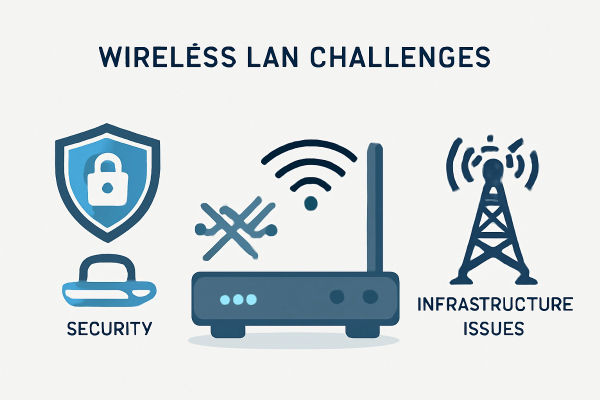
Spectrum Congestion
Even with wider channels and new frequency bands, spectrum is becoming crowded—especially in urban areas. Competing demands from 5G, satellite communications, and IoT deployments are putting pressure on available wireless resources.
Enterprises are being forced to deploy advanced spectrum management tools and consider hybrid connectivity approaches to maintain performance.
Security Concerns in a Hyper-Connected World
As WLAN networks connect more mission-critical devices, the risk of cyberattacks grows. While WPA3 security is standard in 2025, attackers continue to exploit human errors, outdated firmware, and weak IoT security practices.
Network segmentation, Zero Trust architectures, and real-time threat detection are no longer optional—they’re essential.
Complexity in Enterprise Deployments
Modern WLAN deployments require balancing multiple frequency bands, supporting legacy devices, and ensuring smooth integration with other network types.
For IT teams, the complexity of managing large-scale networks has increased dramatically.
Many organizations are now relying on managed WLAN services or cloud-based controllers to reduce operational strain.
Cost Pressures for High-Performance Networks
The move to Wi-Fi 7 and beyond often requires new infrastructure, including upgraded access points, switches, and client devices.
While the long-term benefits are clear, the initial investment can be a challenge for smaller businesses and public institutions.
Balancing performance upgrades with budget constraints is becoming a key strategic decision for CIOs and network planners.
Regulatory and Compliance Requirements
As governments tighten data protection laws, WLAN operators must ensure that networks meet local compliance standards. This is especially important for organizations with cross-border operations, as regulations vary widely between regions.
The Road Ahead
In 2025, WLAN technology is more capable and versatile than ever, but it is also more complex to manage. The future will belong to networks that can seamlessly blend speed, reliability, and security—while adapting to the diverse needs of users and applications.
Industry collaboration will be crucial. Vendors, regulators, and enterprises will need to work together to ensure that WLANs can keep pace with both technological advancements and rising user expectations.
The message is clear: WLAN is no longer just about connecting devices—it’s about enabling the connected future.

