





Waveshare has unveiled the ESP32-P4 WIFI6-POE-ETH, a compact yet highly capable development board designed to address the growing demands of human-machine interface (HMI) terminals and Internet of Things (IoT) gateways.
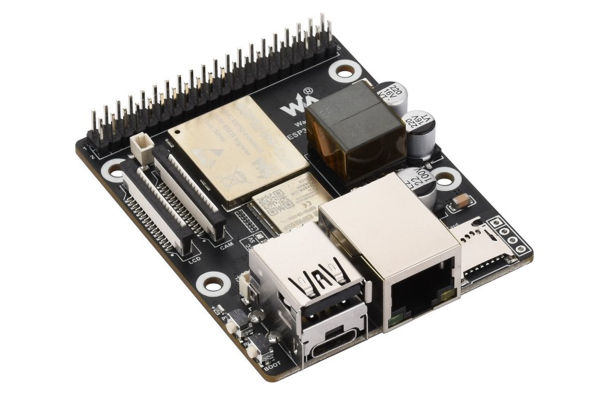
This new board stands out by integrating advanced wireless connectivity, PoE (Power over Ethernet), multimedia capabilities, and a versatile range of interfaces, making it ideal for applications that require robust networking alongside rich HMI features.
Core Architecture and Performance
At its heart, the ESP32-P4-WIFI6-POE-ETH board features the Espressif ESP32-P4-Core microcontroller which is a dual-core RISC-V processor operating at up to 400 MHz. This chip is specifically designed with AI instruction extensions and a single-precision floating point unit, targeting edge AI processing and complex control tasks.
Complementing this is a secondary RISC-V low-power core running at 40 MHz optimized for energy efficiency during idle or background operations.

The board leverages the ESP32-C6 module to deliver next-generation wireless connectivity, including Wi-Fi 6 and Bluetooth 5 (LE) standards.
The inclusion of Wi-Fi 6 offers significant improvements in throughput, capacity, and latency over previous generations, especially in dense network environments. The Bluetooth 5 LE facilitates today’s low-power IoT and wearable device communication.
Rich Multimedia and Sensor Support
One of the board’s standout features is its substantial multimedia processing capability. It incorporates a 2D Pixel Processing Accelerator (PPA) and Video Processing Unit (VPU) that supports H.264 video encoding and JPEG image compression.
These hardware accelerators enable efficient video streaming and image processing, essential for smart panels, multimedia control systems, and interactive displays.
The development board supports both display and camera interfaces through MIPI-DSI and MIPI-CSI connectors. The MIPI-DSI interface is a 2-lane connector compatible with optional capacitive touchscreens of 7-inch or 10.1-inch sizes, which are available as add-ons.
On the imaging side, the MIPI-CSI supports up to 1080p30 video capture and is compatible with Raspberry Pi cameras like the OV5647 sensor, making it suitable for vision-based applications.
Audio input and output are well supported with an onboard microphone, ES8311 audio codec, and NS4150B power amplifier driving an 8-ohm speaker. This audio subsystem equips the platform for voice interfaces, intercoms, or sound-enabled control panels.
 Networking and Power Features
Networking is enhanced through a 100Mbps Ethernet port with PoE support, enabling both data and power delivery over a single cable. This feature dramatically simplifies deployments where power outlets are limited, especially in industrial or commercial settings.
The addition of PoE makes the ESP32-P4-WIFI6-POE-ETH a versatile choice for IoT edge gateways, automated kiosks, and HMI panels needing consolidated power and connectivity.
For USB connectivity, the board includes a USB 2.0 OTG port and USB Type-C port primarily used for power supply, UART communication, and flashing the firmware.
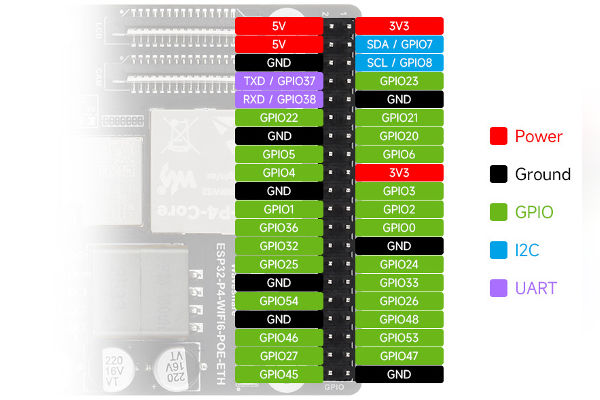
Serial communication options extend to UART, I2C, SPI, PWM, and CAN (TWAI) protocols, supported through a 40-pin GPIO expansion header. This pinout is designed to be broadly compatible with Raspberry Pi-style headers, catering to prototyping and interconnectivity with diverse peripherals.
Memory and Storage
Memory-wise, the board is equipped with 768 KB of high-performance Level 2 SRAM, 32 KB of low-power SRAM, and 32 MB of PSRAM for buffering multimedia data and running AI models locally. Storage includes 32 MB of NOR Flash for firmware and extended application storage plus a MicroSD slot for expandable storage via SDIO 3.0 interface.
Security and Software
Security is a key focus on this development platform. It supports secure boot, flash encryption, cryptographic accelerators, a True Random Number Generator (TRNG), and privileged access separation via a dedicated Key Management Unit (KMU) and digital signature peripherals.
These features build a strong foundation for secure IoT device deployment, safeguarding firmware integrity and sensitive data.
On the software front, the board is compatible with Espressif’s comprehensive ESP-IDF development framework and can be programmed using popular environments like Arduino IDE.
Additional support includes ESP-MDF for mesh networking, LVGL for GUI touchscreen development, ESP-ADF for audio applications, and AI/voice framework integration, enabling developers to build advanced interactive systems efficiently.
 Pricing and Availability
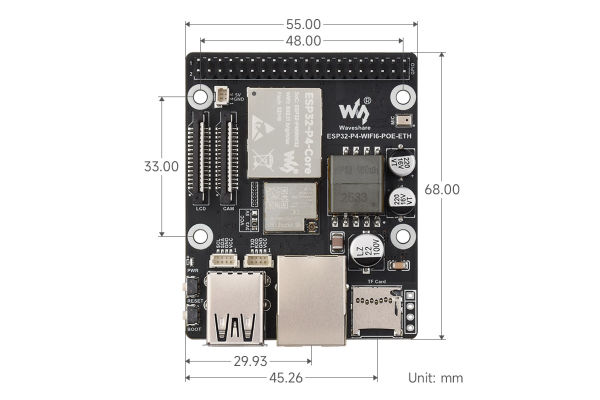
The ESP32-P4-WIFI6-POE-ETH board is offered in multiple variants. The base model provides essential connectivity and interface options, while the Kit-C and Kit-D bundles add peripherals such as speakers, camera modules, and larger capacitive touchscreens up to 10.1 inches.
Pricing varies from around $25 for the standard board to approximately $100 for the fully loaded Kit-D. The board is available through major online distributors including AliExpress, Amazon, and Waveshare’s official store.
Applications and Market Implications
Waveshare’s ESP32-P4-WIFI6-POE-ETH development board is positioned to serve a wide array of embedded system applications requiring high connectivity, multimedia interface, and local processing capabilities.
Use cases range from smart home control panels, industrial machine interfaces, and digital signage systems, to IoT gateways and edge AI devices that demand secure, reliable communications coupled with rich user interaction capabilities.
By combining advanced microcontroller cores, Wi-Fi 6/Bluetooth 5 connectivity, power-over-Ethernet, and multimedia peripherals in a compact form factor, Waveshare delivers a versatile platform that can accelerate the prototyping and deployment of next-generation IoT and HMI solutions.

