





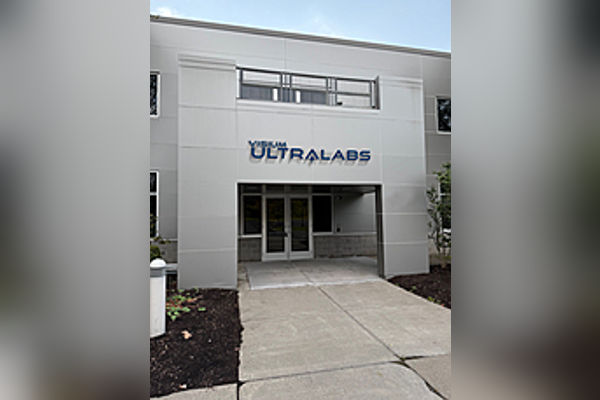
VISIUM announced the official rebranding from Lit Thinking as well as the grand opening of VISIUM UltraLabs, a new 5,000-square-foot research facility located at Cornell Tech Park. The company’s ambitious research program, which seeks to manufacture the first commercially viable Far-UVC LED in the world and make significant advancements in the development of Ultra Wide Band Gap semiconductors, will be centered at the new facility.
By safely and consistently deactivating surface and airborne viruses and bacteria, far-UVC light—more especially, light with a wavelength below 230 nanometers—has shown itself to be exceptional in the field of public health.
It is perfect for usage in populated areas like workplaces, schools, and hospitals because it is safe for human skin and eyes, unlike UVC, which has a larger wavelength. Visium, the company’s main product, is already in use at prestigious institutions like Roger Williams University in Rhode Island, Mt. Sinai Hospital, and the Miami Dolphins.
The goal of VISIUM UltraLabs’ new research center is to overcome the drawbacks of the existing Far-UVC technology, which is dependent on pricey Krypton Chloride lamps. The goal of the company’s research effort is to develop a Far-UVC LED at 230nm that is significantly more efficient.
Due to its affordable mass production, this new technology—which is based on Ultra-wide Bandgap semiconductors with Aluminum Nitride substrates—will enable Far-UVC disinfection to be used in a considerably greater variety of applications.
Beyond Far-UVC applications, VISIUM’s research on Ultra-wide Bandgap semiconductors will lead to important innovations for other industries that need high-performance, high-power semiconductors, such as smart grid systems, power-hungry AI data centers, electric vehicles, and defense and aerospace applications, to mention a few.
Important collaborations with Cornell University and Nagoya University support VISIUM’s research activities. This collaboration gives access to top experts worldwide, such as Nobel laureate Professor Hiroshi Amano, who won the 2014 Nobel Prize in Physics for his research on blue LEDs and who previously worked with Dr. Leo Schowalter to create the first (and only) UVC laser diode in history.
A novel method to electrical conductivity in ultrawide bandgap semiconductors, developed by Profs. Debdeep Jena, Huili (Grace) Xing, and Leo Schowalter, made possible the long-sought and elusive UVC laser diode. Furthermore, the Department of Defense’s financing is being utilized by the robust university partnerships, who acknowledge the potential of Ultra-wide Bandgap semiconductors to offer vital answers.
Leadership Comments
“The creation of a Far-UVC LED will drastically increase the adoption of this critical technology by reducing implementation barriers,” said John Rajchert, CEO of VISIUM. “Our research is akin to the invention of the bright blue LED in the 1990s, which revolutionized the lighting industry. We believe our work will have a similar disruptive impact on the world of public health.”
VISIUM’s CTO, Dr. Leo Schowalter, a Visiting Professor at Cornell, Nagoya University, and UCF, and the former Co-Founder & CTO of Crystal IS, leads VISIUM’s research program. His extensive experience in the field, combined with the academic partnerships and the new lab facility, uniquely positions VISIUM to succeed.

