





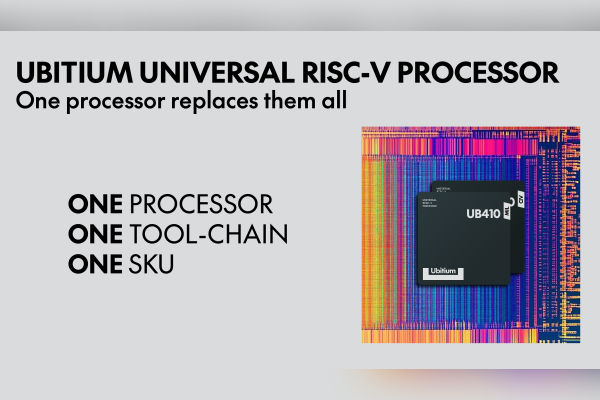
Ubitium, a German semiconductor startup, just announced they’ve taped out their first silicon on Samsung Foundry’s 8nm process, completed back in December 2025. It’s the first truly universal RISC-V processor designed to replace the messy stack of specialized chips cluttering modern embedded systems.
Embedded computing is a $115 billion market that’s hit a wall. Vehicles used to run on one processor; now they pack over 200, each with its own toolchain, software stack, and supplier.
Performance isn’t the issue anymore, complexity is. As AI workloads flood into robots, drones, and factory machines, that fragmented approach just isn’t sustainable.
Ubitium builds on RISC-V, the open-source architecture already powering billions of chips worldwide and takes it way beyond a standard CPU.
Their universal processor runs Linux and RTOS at the same time, handles real-time radar and audio signals, and crunches neural networks for edge AI inference. No separate accelerators or coprocessors needed, and it keeps full RISC-V software compatibility.

Think of it like software-defined radio did for wireless, Ubitium swaps fixed-function hardware for one reconfigurable chip. The payoff is Embedded systems that ship faster, cost less, and last longer.
They’re teaming up with Samsung Foundry, Siemens Digital Industries Software, and ADTechnology to push toward production silicon.
Leadership Comment
“This tape-out turns a long-held thesis into silicon,” says Ubitium CTO Martin Vorbach. “Embedded workloads have outgrown the architectures the industry relies on today. Consolidation isn’t optional anymore. It’s inevitable.”
Industry Comments
“The shift toward software-defined, reconfigurable compute is accelerating,” says Taejoong Song, VP and Head of Foundry Technology Planning at Samsung Electronics. “Ubitium’s approach—one universal processor replacing multiple specialized chips—aligns with where we see embedded systems heading. We’re proud to manufacture their first silicon.”
“Shift-left verification helps teams validate system behavior earlier by running more realistic workloads ahead of first silicon,” adds Jean-Marie Brunet, SVP of Hardware Assisted Verification at Siemens Digital Industries Software. “Ubitium’s use of our EDA tools, specifically the Veloce CS system, shows how early validation de-risks integration and speeds time to silicon.”
“Advanced-node silicon delivery depends on disciplined back-end execution across timing, power, and signoff,” says Jun-Kyu Park, CEO of ADTechnology. “We’re pleased to have supported Ubitium through tape-out on Samsung’s 8nm process.”

The founders bring serious credentials
CTO Martin Vorbach created PACT XPP (an early reconfigurable processor) and holds 200+ processor patents. The core team combines deep experience from Intel, Texas Instruments, Apple, and NVIDIA, with 350+ peer-reviewed publications.
This tape-out validates their architecture’s foundations, the Universal Processing Array with runtime reconfiguration and LPDDR5 memory interface. They’re aiming for a second tape-out later this year, with volume production in 2027.
To Know More: CLICK HERE

