





The automotive industry is undergoing a sweeping transformation, driven by rapid advancements in computing technology. In 2025, several key trends are fundamentally reshaping how vehicles are designed, operated, and experienced. This article explores the most critical technical developments shaping Automotive Computing in 2025, with a focus on innovations making vehicles smarter, safer, and more connected.
Software-Defined Vehicles (SDVs)
Software-defined vehicles represent a paradigm shift from hardware-centric design to software-driven functionality. Centralized computing architectures and domain controllers are replacing dozens of traditional electronic control units (ECUs), enabling continuous feature evolution through over-the-air (OTA) updates and making vehicles infinitely customizable post-sale.
Companies such as Mercedes-Benz, Volvo, and BMW are leading deployments with advanced compute platforms like NVIDIA DRIVE and Qualcomm Snapdragon Ride.
SDVs require:
- Embedded software development expertise
- Model-based design and formal verification to meet ISO 26262 and ASPICE compliance
- Adoption of abstraction layers and standardized APIs for modularity
- System integration for seamless OTA and predictive diagnostics
This shift is facilitating feature-on-demand business models and transforming vehicles into upgradable, service-oriented platforms.
Autonomous Driving and Advanced Driver-Assistance Systems (ADAS)
Autonomous driving continues to accelerate, with Level 4 vehicle deployments present in select urban fleets and robotaxi pilots globally. Highly sophisticated sensor fusion algorithms, leveraging data from lidar, radar, and cameras, now enable AI-powered edge inference engines for real-time perception and decision-making.
Key technical focus areas include:
- Real-time, redundant perception stacks for safety
- Advanced machine learning and deep neural networks for object detection, path planning, and behavior prediction
- Fail-operational architectures and AI validation systems
- Digital twins and synthetic data to handle edge-case testing
ADAS features—with adaptive cruise control, highway autopilots, and hands-off lane-centering—are becoming standard benchmarks in both premium and mainstream vehicles.
Vehicle-to-Everything (V2X) Connectivity
The rise of V2X (Vehicle-to-Everything) communications is unleashing a new era of cooperative mobility and road safety. 5G-powered C-V2X connectivity allows vehicles to communicate with infrastructure, other vehicles, and pedestrians.
Key Advances Include:
- 5G New Radio (NR), multi-access edge computing (MEC), and low-latency protocols (IEEE 802.11p, DSRC)
- Secure communication protocols for real-time information exchange
- AI-powered edge decision-making
- Interoperability standards across connected ecosystems
These technologies underpin smart city integration, congestion mitigation, and enable advanced safety features at urban and highway speeds.
Artificial Intelligence, Predictive Engineering, and the Rise of Automotive AI
AI and machine learning are now at the core of automotive computing, embedded in everything from predictive maintenance and crash avoidance to driver modeling and natural language vehicle interfaces.
The industry is rapidly adopting:
- End-to-end AI models for perception and decision-making
- Generative AI and simulation to accelerate engineering design cycles
- Agent-based and predictive systems for fleet-wide optimization
High-performance onboard compute (CPUs, GPUs, and NPUs) are vital, supporting real-time i exponentially as AI features evolve.
Edge and Cloud Computing
The growth in sensor data and real-time processing demands has led to hybrid cloud-edge architectures.
Vehicles rely on high-bandwidth, low-latency edge compute for immediate decision-making while leveraging cloud platforms for data analytics, training AI models, and OTA updates.
This ecosystem is crucial for enabling future applications, reducing physical recalls, and dynamically optimizing vehicle performance.
High-Performance System-on-Chip (SoC) Architectures
Modern vehicles are integrating advanced SoCs that unify processors, memory, and sensor interfaces onto a single chip. These platforms power the latest ADAS, infotainment, and connectivity systems with greater efficiency, security, and scalability.
Innovations in automotive SoCs, from both established and emerging silicon providers, are critical for future-proofing vehicles and supporting compute-intensive workloads, especially AI/ML operations at the edge making a key trend shaping automotive computing in 2025.
Digital Cockpit and Human-Machine Interface (HMI) Innovation
The automotive cockpit of 2025 is being reimagined with high-resolution, multi-display dashboards, augmented reality head-up displays, natural-language AI assistants, and seamless integration with connected services.
Designing for ultra-low latency, rich graphical interfaces, and multimodal user experiences is now a core requirement in automotive computing, meeting consumer demand for a smartphone-like experience on wheels.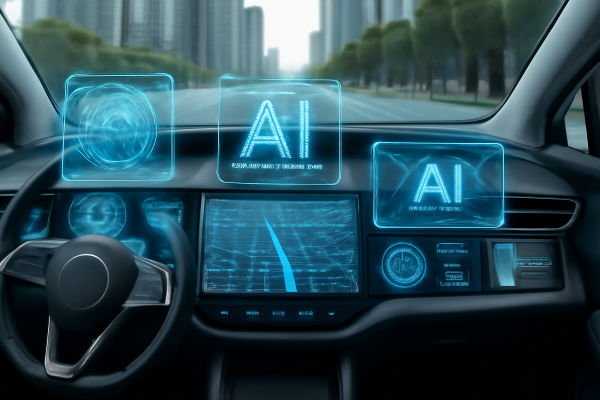
Automotive Computing in 2025
Automotive computing in 2025 is defined by centralization, intelligence, and connectivity. Software-defined platforms, autonomous technologies, AI and edge computing, V2X, and next-generation SoCs are converging to deliver vehicles that are safer, smarter, and constantly evolving. Manufacturers who prioritize these technical pillars are poised to lead the next decade of automotive innovation.

