

As edge AI, automotive systems, 5G infrastructure, and data center architectures evolve in 2025, one technology sits at the convergence of all these advancements—Field Programmable Gate Arrays (FPGAs).
These flexible, reprogrammable chips are now more powerful and scalable than ever, offering customized acceleration and near-ASIC performance with software-like agility. The global FPGA market, projected to exceed $15 billion in 2025, is rapidly transforming with new players, acquisitions, and specialized vertical solutions.
In this exclusive article, The Volt Post profiles the Top FPGA Technology Companies in 2025, based on innovation, performance benchmarks, ecosystem leadership, and market influence.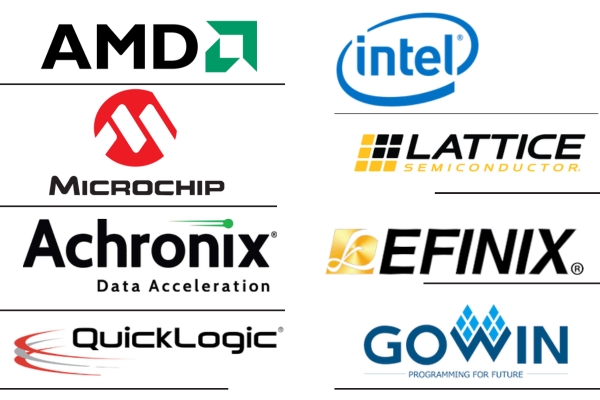
AMD (Xilinx Division)
Tagline: Reconfigurable Intelligence for the Data-Driven World
AMD, after acquiring Xilinx for $49 billion in 2022, has emerged as the undisputed leader in the FPGA domain. In 2025, its Versal Adaptive Compute Acceleration Platforms (ACAPs) continue to set benchmarks for AI inference, signal processing, and software-defined radio (SDR). With tight integration across AMD’s CPU, GPU, and AI product stack, the Xilinx legacy lives on in advanced automotive, telecom, and aerospace applications.
-
Key Offering: Versal AI Core & Premium ACAPs
-
Segment Strengths: 5G base stations, radar systems, adaptive AI at the edge
-
What’s New in 2025: Expanded support for software-defined workloads using AMD ROCm and Vitis toolchain
Intel (Altera Division)
Tagline: Smart, Connected, and Reprogrammable
In a strategic move in 2024, Intel revived the Altera brand to bring sharper focus to its programmable logic offerings. The Agilex 9 FPGAs, launched in early 2025, are optimized for AI accelerators and high-speed connectivity, supporting PCIe 6.0 and CXL 3.0. Intel’s seamless interface with oneAPI makes it a go-to choice for developers who prioritize performance portability across CPUs, GPUs, and FPGAs.
-
Key Offering: Agilex 7 and Agilex 9 FPGA families
-
Segment Strengths: Data centers, embedded AI, SmartNICs
-
What’s New in 2025: Launch of OpenFPGA development initiative for collaborative FPGA software tooling
Microchip Technology (Microsemi FPGA)
Tagline: Secure. Reliable. Low-Power.
Microchip’s PolarFire and IGLOO FPGA families continue to dominate the low-power and secure FPGA market in 2025. These FPGAs are the top choice for aerospace, defense, and industrial automation—domains that demand deterministic, low-power, and radiation-tolerant architectures. The recent launch of PolarFire SoC v2 brought in enhanced Linux-capable RISC-V cores integrated with real-time logic.
-
Key Offering: PolarFire SoC v2
-
Segment Strengths: Avionics, IoT edge devices, military-grade systems
-
What’s New in 2025: Advanced support for formal verification and RISC-V ecosystem expansion
Lattice Semiconductor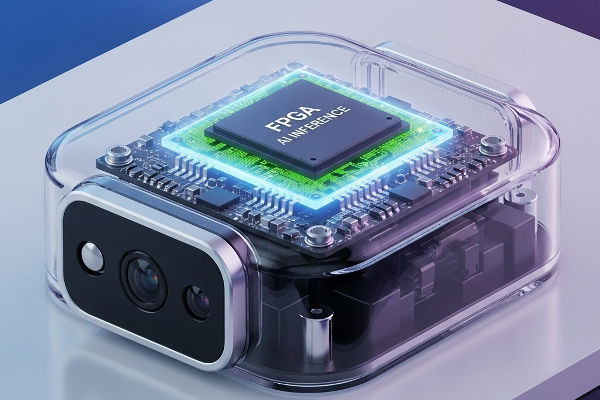
Tagline: The Smallest FPGA, the Smartest Edge
Lattice is riding high on its role as the champion of ultra-low-power and small-footprint FPGAs in 2025 – making space in our Top FPGA Technology Companies.
The Lattice Avant and Nexus platforms are powering next-gen computer vision, robotics, and secure connectivity solutions. Its drag-and-drop AI design suite, Lattice sensAI™, is driving rapid prototyping for AI at the edge.
-
Key Offering: Avant-G, CrossLink-NX, Certus-NX
-
Segment Strengths: Edge AI, embedded vision, consumer electronics
-
What’s New in 2025: Expansion into AI co-processing units for wearables and industrial sensors
Achronix Semiconductor
Tagline: Speedster FPGAs for Hyperscale Needs
Achronix specializes in high-performance, high-speed FPGAs for custom compute acceleration. Its Speedster7t devices are being widely adopted by hyperscalers and AI companies for data-intensive workloads, offering 400G Ethernet, GDDR6 interfaces, and hardened ML blocks. Achronix’s embrace of chiplet architectures and custom IP licensing gives it a unique edge in the FPGA ecosystem.
-
Key Offering: Speedster7t FPGAs and VectorPath accelerator cards
-
Segment Strengths: AI/ML inference, SmartNICs, custom SoCs
-
What’s New in 2025: Launched FPGA-as-a-Service IP Licensing Platform
Efinix Inc.
Tagline: Reimagining FPGAs from the Ground Up
Efinix’s breakthrough Quantum™ architecture allows more logic density in a compact power envelope—ideal for edge AI, wearables, and smart city applications. In 2025, the company is gaining ground with its Trion and Titanium FPGA series, which offer better power efficiency at significantly lower costs.
-
Key Offering: Titanium and Trion FPGAs
-
Segment Strengths: Vision systems, IoT nodes, smart healthcare
-
What’s New in 2025: Integrated tinyML acceleration blocks in its Titanium product line
QuickLogic Corporation
Tagline: Open Source, Always-On
QuickLogic is blazing a trail in open-source FPGA development, thanks to its partnership with Google and support for the SymbiFlow ecosystem. The company’s EOS S3 SoCs and QORC toolchain are powering energy-efficient always-on sensing in mobile and voice-based interfaces.
-
Key Offering: EOS S3, QuickFeather Dev Kit
-
Segment Strengths: Voice assistants, hearables, smart home
-
What’s New in 2025: Extended AI/ML support for open-source FPGA SDKs and Python-native tools
Gowin Semiconductor
Tagline: China’s Rising FPGA Powerhouse
Making it into our Top FPGA Technology Companies, Gowin is one of the fastest-growing FPGA companies in Asia, with its GW1N and GW2A families finding widespread adoption in consumer electronics, security cameras, and display solutions. The company’s success lies in balancing cost-effective design with reliable performance and fast delivery timelines.
-
Key Offering: GW1N-UV, GW5AST FPGA
-
Segment Strengths: LED displays, camera modules, IoT edge
-
What’s New in 2025: Collaboration with Chinese cloud giants for custom AI FPGAs
Alongwith, Top FPGA Technology Companies Here Are The Emerging Trends in FPGA Market 2025
1. Chiplet Integration
Many FPGA vendors are adopting chiplet-based SoC design, enabling customization of FPGA fabrics with hardened AI cores, DDR controllers, and PCIe interfaces.
2. Open Source Toolchains
The rise of platforms like OpenFPGA, SymbiFlow, and F4PGA is democratizing FPGA development, especially in academic, hobbyist, and startup ecosystems.
3. FPGA in AI Inference
FPGAs are now key players in AI inference at the edge, offering reprogrammability and low-latency acceleration compared to GPUs or CPUs.
4. Security-Centric FPGAs
FPGAs with built-in quantum-resilient encryption and tamper resistance are in demand for defense and mission-critical systems.
Conclusion: The Reprogrammable Future
FPGAs have evolved from niche components to mainstream compute engines across verticals. In 2025, innovation is not just about logic density, but about building programmable systems that can evolve with the workloads they serve.
Whether it’s cloud-scale AI, real-time industrial control, or personalized consumer experiences, FPGA companies are at the heart of this revolution.
The next five years will be defined by how these companies build developer ecosystems, integrate with AI workloads, and scale globally.