





The Indian Institute of Technology Madras (IIT Madras) has launched two groundbreaking silicon photonics products developed entirely within India.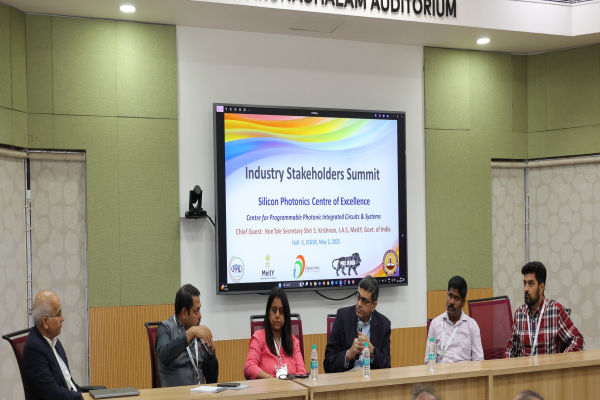
These innovations, unveiled by S. Krishnan, Secretary of the Ministry of Electronics and Information Technology (MeitY), underscore India’s growing prowess in advanced photonics and quantum technologies.
Pioneering Indigenous Photonics
The two products— a Quantum Random Number Generator (QRNG) module and a Fibre-Array Unit (FAU) attachment tool—were developed at the Centre of Excellence for Compound Photonics Integrated Circuits and Systems (CoE-CPPICS) at IIT Madras.
This marks the first time such advanced silicon photonics products have been conceived and realized entirely within the country.
The QRNG module, a critical component for secure communications and cryptographic applications, has already been deployed at the Society for Electronic Transactions and Security (SETS) in Chennai. Its commercial availability is being facilitated through “LightOnChip Pvt. Ltd.,” a spin-off from CPPICS, aiming to bring this technology to a broader market.
The FAU attachment tool addresses the intricate challenges of photonic chip packaging, a vital aspect of integrating photonic components into practical systems.
By developing this tool indigenously, IIT Madras is contributing to the establishment of a self-sufficient photonics manufacturing ecosystem in India.
Leadership Perspectives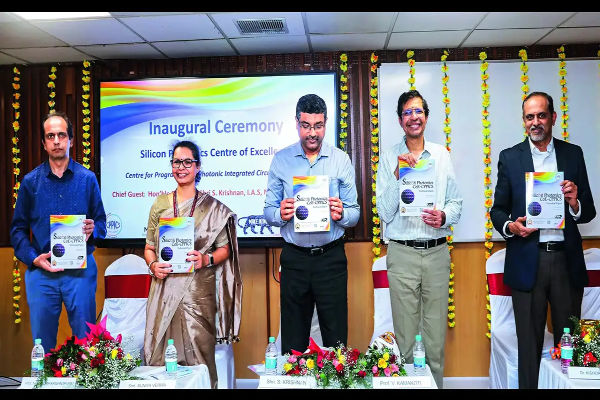
S. Krishnan, IAS, Secretary of MeitY, lauded the achievement, stating, “The indigenously developed field-deployable silicon photonic-based QRNG module is a matter of national pride. Its deployment at SETS Chennai for commercial services exemplifies India’s capabilities in advanced quantum technologies.”
Prof. V. Kamakoti, Director of IIT Madras, emphasized the broader impact: “Silicon Photonics is an emerging technology that will help design much more efficient and complex hardware for the future. I am very happy that the Silicon Photonics CoE-CPPICS Centre at IIT Madras has now come out with demonstrable products that can be quickly adopted by the market. We hope that multiple such products will continue to come in the future.”
Prof. Bijoy Krishna Das, Chief Investigator at CoE-CPPICS, highlighted the collaborative effort: “We are now fully equipped with the entire value chain of silicon photonics product development by leveraging the strongest silicon photonics research team and the world-class silicon photonics chip design and testing facility at CPPICS.”
Strategic Collaborations and Future Outlook
The development of these products was made possible through strategic collaborations with international and domestic partners.
The silicon photonics chips were fabricated using CMOS-compatible processes at Silterra Malaysia, while izmo Microsystems provided expertise in photonic integrated circuit packaging.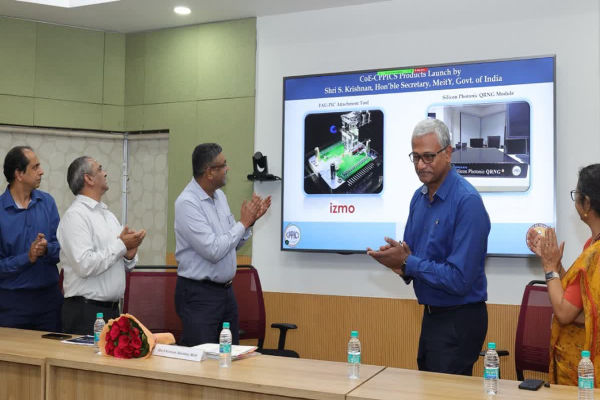
These partnerships have not only facilitated the current achievements but also laid the groundwork for future innovations. The CoE-CPPICS aims to continue this trajectory by fostering an environment conducive to research, development, and commercialization of silicon photonics technologies.
The global market for silicon photonics is projected to reach USD 10 billion by 2030. India’s entry into this domain through indigenous development positions the country to be a significant player in the global photonics industry.
Applications and Implications
The QRNG module has a wide array of applications, including
- IT security for military and defense
- Cryptographic algorithms
- Quantum key distribution (QKD)
- Scientific modeling and simulations
- Financial transactions and blockchain technologies
- Gaming applications requiring high-quality randomness
By addressing these critical areas, the QRNG module contributes to enhancing the security and efficiency of various systems, both in the public and private sectors.
The launch of these indigenous silicon photonics products by IIT Madras represents a significant milestone in India’s journey towards technological self-reliance. Through strategic collaborations and a focus on innovation, the country is poised to make substantial contributions to the global photonics landscape.

