





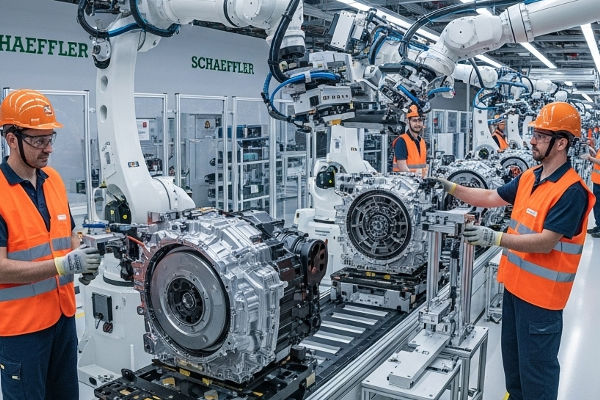
In a strategic push to strengthen its presence in India’s rapidly transforming mobility sector, Schaeffler India has unveiled its fifth manufacturing facility, located in Hosur, Tamil Nadu.

© 2025 The Volt Post / Custom AI-Generated Render
The new plant is poised to become a cornerstone in Schaeffler’s vision of developing advanced powertrain solutions tailored for electric vehicles (EVs), hybrids, and traditional internal combustion engine (ICE) platforms.
This development comes at a crucial time as India ramps up its clean mobility agenda, while global automotive OEMs seek more resilient, flexible, and localized supply chains.
To Support Domestic and Export Demands
With an initial investment that underscores the company’s confidence in the Indian market, Schaeffler’s Hosur plant is designed to scale rapidly to support both domestic and export demands.
This facility will primarily manufacture engine and transmission components, including clutch systems, torque converters, gears, and other high-precision parts, all essential to powertrain operations across vehicle segments.
“This plant is more than just an expansion—it’s a statement. We are ready to support India’s mobility revolution and build for the world from here,” said Harsha Kadam, MD & CEO, Schaeffler India.
Sustainability as a Core Pillar
The Hosur facility is designed with sustainability-first principles:
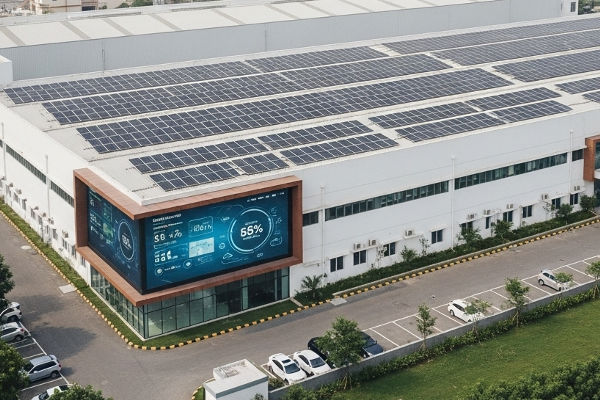
- Solar rooftop systems to power operations
- Rainwater harvesting and zero liquid discharge systems
- Energy-efficient utilities for reduced carbon footprint
This aligns with Schaeffler’s global carbon neutrality roadmap, ensuring that growth does not come at the expense of the environment.
© 2025 The Volt Post / AI Conceptual Visualization
Strategic Location: Tamil Nadu – India’s Emerging EV & Auto Component Hub
Located near major auto OEMs like Ashok Leyland, Ola Electric, TVS Motor Company, and Hyundai, the Hosur facility offers Schaeffler direct access to a thriving automotive ecosystem. Tamil Nadu is quickly solidifying its position as India’s EV manufacturing powerhouse, with over INR50,000 crore in EV-related investments announced in just the past three years.
“Tamil Nadu provides unmatched infrastructure, policy support, and skilled labor—making it the ideal destination for future-ready manufacturing,” said a state industry department official.
What Will Be Manufactured at Hosur?
Schaeffler’s Hosur plant will specialize in:
- Clutch assemblies & systems
- Hydraulic clutch release systems
- Manual transmission components
- EV drivetrain sub-assemblies
- Mechatronic components for hybrid systems
The plant will cater to:
- 2W and 3W EV manufacturers
- Passenger vehicle OEMs
- Commercial and off-highway vehicle manufacturers
- Aftermarket and export clients
Expanding Schaeffler’s India Footprint
This new addition marks Schaeffler India’s fifth plant, joining its existing manufacturing facilities in:
-
Pune (Maharashtra)
-
Savli (Gujarat)
-
Maneja (Gujarat)
-
Jamshedpur (Jharkhand)
With this expansion, Schaeffler India is doubling down on its commitment to “Make in India” and “Make for Global Markets.”
“This expansion also allows us to better serve OEMs and Tier-1 suppliers in South India with shorter lead times, reduced logistics costs, and stronger localization, said Harsha Kadam, CEO and Managing Director of Schaeffler India.”
Employment and Skill Development
The Hosur plant will generate over 200 direct jobs in its initial phase, with plans to scale to 500+ as production lines expand. The company has also partnered with local ITIs and technical institutions to train and upskill talent, with a focus on Industry 4.0 practices, digital manufacturing, and green technologies.
Market Context: Why Powertrain Innovation Matters in 2025
India’s auto industry is going through one of its biggest transitions ever:
-
The government targets 30% EV penetration by 2030
-
Hybrid technologies are gaining momentum for the interim period
-
Stricter BS VI Phase II emission norms have made powertrain optimization essential
-
OEMs are demanding lightweight, modular, and energy-efficient systems that meet both global regulations and consumer expectations
With these shifts, suppliers like Schaeffler are no longer just component manufacturers—they are becoming engineering innovation partners.
“As we move toward cleaner, smarter mobility, suppliers with deep R&D capabilities and scalable production footprints like Schaeffler are crucial for OEM success,” said an automotive analyst at CRISIL.
Global Supply Chain Integration
© 2025 The Volt Post / AI-Generated Concept
Beyond India, the Hosur plant will supply to global Schaeffler hubs in Europe, Southeast Asia, and North America. This aligns with the company’s broader strategy to de-risk global operations by expanding regional production and diversifying suppliers.
“Geopolitical uncertainty and logistics disruptions over the past few years have made localization a global priority. Plants like Hosur are not just Indian assets—they’re global anchors,” said a senior supply chain manager at a German OEM.
Business Outlook: Schaeffler India’s Momentum
-
Q1 2025 Revenue: Estimated ?1,600 crore with 12% YoY growth
-
Export Share: Rising due to European powertrain orders
-
EV Portfolio: Schaeffler is developing e-axles, e-clutches, and e-motors at its R&D centers
-
R&D Spend (India): Over ?250 crore projected for 2025
Schaeffler’s India strategy is now clearly anchored in mobility transformation, sustainability, and global integration.
Schaeffler India’s new Hosur facility is more than just a factory—it’s a symbol of industrial transformation, a node in the global EV supply chain, and a testament to India’s rising role in the future of mobility.
As the nation pushes toward clean and connected transport, plants like these will define the pace, scale, and sustainability of progress.

