



SanDisk has unveiled a groundbreaking enterprise-grade NVMe SSD featuring an unprecedented 256TB capacity, constructed on its new UltraQLC flash memory platform. This massive storage device, arriving in a U.2 form factor, is designed for hyperscale cloud service providers and enterprises dealing with high-density data and AI workloads.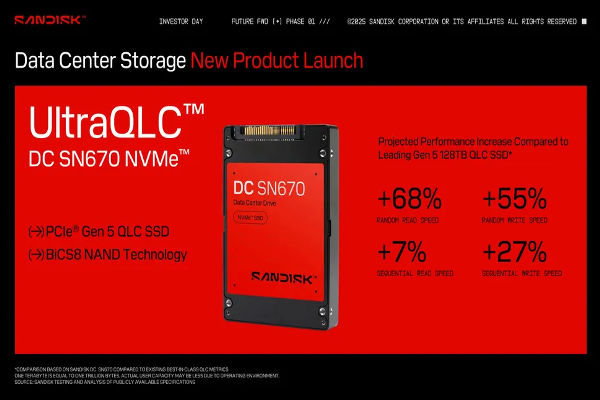
The UltraQLC platform departs from traditional SSD designs by enabling the controller to write data directly to QLC NAND memory rather than utilizing a pseudo-SLC buffer.
This “Direct Write QLC” technology aims to simplify the writing process and ensure power-loss safe writes on the first attempt, albeit with some trade-offs in latency and throughput compared to pseudo-SLC caching.
SandDisk mitigates performance drawbacks through a large DRAM buffer, advanced memory parallelism, and dynamic frequency scaling, which purportedly boosts performance at any power level by about 10%.
Additional innovations include a Data Retention profile that reportedly reduces retention-related recycling by up to 33%, thereby improving reliability and energy efficiency. The SSD uses SandDisk custom multi-core controller and 2Tb BiCS8 3D QLC NAND chips.
While the raw QLC NAND is slower than pseudo-SLC enhanced drives, the absence of pseudo-SLC caching means performance remains consistent over extended writes, which can be beneficial for large datasets typical in AI training and cloud data centers.
SandDisk also announced a related SN670 SSD series, leveraging the UltraQLC technology. Both the 256TB and a 128TB version are expected to ship by the first half of 2026.
This launch reflects SandDisk’s strategic focus on enhancing storage density, efficiency, and performance for data center environments, where traditional HDDs still hold cost and endurance advantages at lower capacities but cannot rival the scale and velocity of modern SSDs.