





Pickering Interfaces has announced a significant addition to its wide range of PXI FIU (fault insertion unit) switch modules. The models 40-205 (PXI) and 42-205 (PXIe), which are part of the company’s two-wire serial interface fault insertion switching family, are available in a compact single-slot form factor.
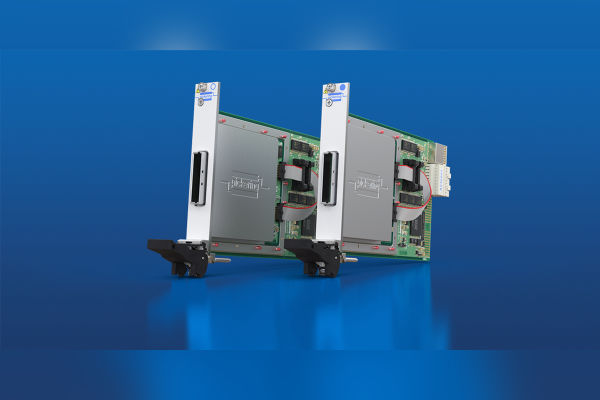
The modules, which are based on MEMS (micro-electro-mechanical systems) switches, are designed to simulate common faults in high-speed communication protocols, meeting the most recent MultiGBASE-T1 testing requirements.
With networking data speeds currently reaching up to 10 Gbps, the modules are primarily intended for automotive HIL (hardware-in-the-loop) simulation applications, specifically for design verification of the newest high-bandwidth MultiGBASE-T1 Ethernet networking components, such as ADAS (advanced driver-assistance systems) controllers.
Utilizing the latest MEMS switching technology from partner Menlo Micro, the signal channels have:
- Low insertion loss and VSWR, as well as excellent and repeatable RF characteristics beyond 6 GHz, with each path having a nominally equal insertion loss.
- The modules also minimize the injection of noise and unwanted signals into the signal path by careful attention to mechanical and electrical design.
- Each channel can support up to 0.5 A and is rated to 100 V between wire pairs.
- The pairs have controlled transmission line impedance suited to most single twisted pair signaling systems.
- The fault buses are each capable of carrying 1.6 A of current, allowing multiple channels to be connected to the same fault condition.
- Each fault bus has an EMR changeover relay, allowing the user to select alternative external fault conditions.
To accommodate multiple customer/application-specific MultiGBASE-T1 connector families, the module features:
- A single high-speed connector interface that routes to a breakout accessory,
- Which converts to multiple Rosenberger H-MTD series connectors for the channel connections,
- Along with a 9-way D connector for the fault bus connections,
- Other automotive Ethernet connector interfaces can be supported on request.
- Breakout modules are available with mounting options either for cabinet shelves or secured to a 1U standard 19” rack mount panel.
The FIU is used to confirm that the controller operates consistently and safely even when there are a variety of connectivity issues. Because single pair Ethernet is easier to install, less expensive, and lighter than typical Ethernet CAT 5/6 cabling, it is also becoming more and more popular in industrial and aerospace applications.
As testing requirements change, customers can future-proof their systems with a single solution that supports communication protocols ranging from the latest 10GBASE-T1 automotive Ethernet standard to the legacy 10BASE-T1 with four or eight channels of impedance-matched 2-wire signal routes.
The 2-wire channels go straight through the module in its default setting with negligible signal loss. As an alternative, shorts can be applied across wire pairs or any wire can be configured as open-circuit. Two fault buses, each with EMR changeover connectivity, can also be used to connect faults to one of four external signals. These faults are usually used to simulate resistive problems between channels or connections to supply voltage/ground.
All versions have a relay cycle counting capability that helps with module “health monitoring” by letting users know which pathways are being used the most.
The operating life of relays might be extended by using this information to update system connections, which would allow signals applied to frequently used contacts to be switched with those applied to less often used contacts.
But before any signal path gets close to its operating life, the 3 billion operation specification would indicate a sizable amount of usage.
 Leadership Comments
“Our state-of-the-art MEMS-based modules offer multiple advantages that—combined—are simply not available with other switching technologies,” explains Steven Edwards, Head of Product Management at Pickering. “Capability limitations mean that the high-speed bandwidth requirements of the latest MultiGBASE-T1 protocols cannot be supported with reed relays or EMRs (electromechanical relays)—dictating the use of advanced MEMS switches to deliver our highest bandwidth FIUs to date. Speed of operation is 50 µs for the signal switches, significantly increasing test system throughput. Longevity is also vastly extended by an operational life of more than 3 billion operations that maximizes service life, minimizing system downtime.”
Pickering Interfaces offers its manufactured products with a standard three-year warranty and guaranteed long-term product support, providing users with peace of mind.
To Know More About Its Pricing, Availability and Contact Information, CLICK HERE

