





Pickering Electronics has announced the availability of another educational application guide, High Potential Testing: Achieve Accurate, Reliable Dielectric Testing with Reed Relay Technology’, which is intended for engineers building test systems to perform hipot electrical safety testing to confirm the effectiveness of insulation in electrical products and systems.
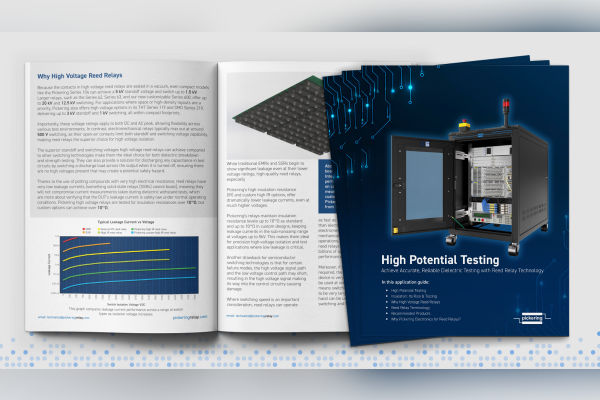
The efficacy of insulation in electrical systems and products has been verified via hipot testing. It comprises two related techniques: dielectric withstand (hipot) testing, which applies a specified overvoltage and verifies leakage stays within acceptable bounds, and dielectric breakdown testing, which increases voltage until true limits are not established.
In addition to being impacted by ageing variables such temperature, humidity, dust, chemicals, bending, and thermal cycling, both call for precise low-current measurement while applying high voltage.
High-voltage reed relays are a natural fit for this environment. Hermetically sealed contacts in an inert atmosphere or near-vacuum avoid the oxidation and contamination issues that affect open-air electromechanical relays.
Compared with solid-state switches, reed relays offer very low leakage thanks to high insulation resistance and careful pin spacing, along with stable contact resistance and fast operate times that support repeatable test results.
Leakage currents in electromechanical relays (EMRs) and solid-state relays (SSRs) rise quickly as voltage increases, often reaching the microamp range.
By contrast, reed relays – and particularly Pickering’s high insulation resistance designs – maintain leakage in the sub-nanoamp region even at kilovolt levels. This stability is critical for producing reliable hipot test results across dielectric withstand and breakdown methods.
This application guide not only explains the theory behind dielectric testing but also gives practical insights into how reed relays can improve test accuracy, reduce leakage, and deliver long-term reliability.
Download the free guide to reveal Pickering’s expert insights and recommendations on selecting the right relay technologies for your specific needs – and discover why reed relays are the ideal high voltage switching technology for hipot testing.
Pickering’s reputation for reed relay innovation is founded on decades of manufacturing excellence. Its relays use instrumentation-grade reed switches for stable, long-life operation—up to billions of cycles—along with formerless coil construction and the company’s patented SoftCenter technology, which improves mechanical robustness.
 Leadership Comments
“This expert-authored comprehensive application guide outlines the vital role of insulation in safe electrical products and systems – as well as the importance of hipot testing in verifying insulation effectiveness and ensuring its integrity,” said Robert King, Reed Relays Product Manager at Pickering Electronics. “And it goes on to explain why high voltage reed relays are ideal for use in hipot test equipment/stations used for determining dielectric breakdown voltages and verifying dielectric withstand voltages – where their compact form factor, high reliability, and inherently very low leakage current means they outperform EMRs (electromechanical relays) and SSRs (solid-state relays).”
Internal or external mu-metal screening enables high packing densities with minimal magnetic interference – and every relay is 100% tested, including dynamic contact wave-shape analysis, to ensure consistent quality.
Learn about 10 key advantages Pickering’s reed relays offer over competitor relays: pickeringrelay.com/10-key-benefits/

