





OMC is introducing innovative cobot technology to its Cornwall fiber optic manufacturing line. OMC is now implementing the first of several collaborative robots (cobots), which are made to securely work alongside human operators in a shared workspace, after conducting research with a local robotics lab and conducting testing at its production facility.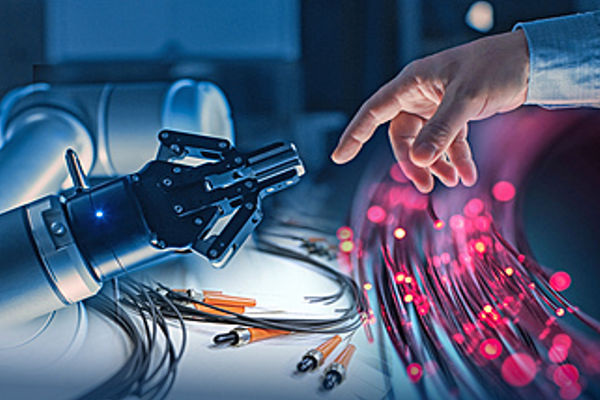
By helping with labor-intensive, repetitive, and time-consuming operations that skilled human operators frequently become weary of, the cobots will boost throughput and capacity by up to ten times while, more importantly, preserving quality and guaranteeing consistency.
OMC is introducing innovative cobot technology to its Cornwall fiber optic manufacturing line. OMC is now implementing the first of several collaborative robots (cobots), which are made to securely work alongside human operators in a shared workspace, after conducting research with a local robotics lab and conducting testing at its production facility.
By helping with labor-intensive, repetitive, and time-consuming operations that skilled human operators frequently become weary of, the cobots will boost throughput and capacity by up to ten times while, more importantly, preserving quality and guaranteeing consistency.
OMC has long been assessing next-generation robotic automation technologies as part of this culture of continuous improvement, but it has remained committed to striking a balance between possible efficiency gains and quality concerns in order to maintain the performance, robustness, and consistency standards required in long-life industrial applications.
Having worked closely with its robotics partners to design specific tooling and to train and calibrate the cobots, experienced operators are now working closely alongside the cobots to boost throughput and capacity while preserving quality and assuring consistency.
This approach contributes to the explanation of why OMC consistently outperforms industry trends. Raw material costs increased by 50% to 100% as a result of post-pandemic inflation, and many market participants raised prices by 70% or more in response.
OMC declined to accept price increases as a way to address these issues. Rather, the business capitalized on the results of its careful long-term financial management, investing large amounts of reserve capital in technology and cost-cutting strategies, as well as improving buffer stocks of essential materials to lower costs and protect supply.
The company was able to keep its average sale prices within 10–15% of their pre-pandemic levels because to this creative strategy. OMC technologies are used in a wide range of applications where reliability and long-term performance are crucial.
Millions of people use OMC products on a daily and worldwide basis in a variety of industries, including transportation, aerospace and defense, research and instrumentation, medical and power distribution, industrial and consumer electronics, signage, commercial or residential buildings, and leisure.
Without even realizing it, these products make their daily lives safer and easier. OMC’s diverse, international end-user base, which places a high priority on export, includes top universities, public sector organizations, and research institutes in addition to SMEs and multinational enterprises.
Leadership Comments
William Heath, Commercial Director, OMC said, “Continuous innovation has been key to our company’s success over the last 40 years. Our innovations span both technological and environmental improvements—and can be grouped into three broad categories: product, process and workplace.”
William Heath, Commercial Director, OMC said, “Global electrification is driving increased demand for our fibre-optic datalinks—particularly for applications requiring isolation in high voltage, transportation and medical sectors—and this development allows us to respond with considerably enhanced throughput and efficiency. With each skilled operator supervising multiple cobots, productivity can be increased up to 10x, reducing time-consuming and repetitive manual tasks to improve their working environment.”
To Know More: CLICK HERE

