





The architecture and performance specifications of NextSilicon’s Maverick-2, the next-generation processor that would enable orders of magnitude greater computation for AI and HPC, were revealed:
- Built on the Intelligent Compute Architecture, the dataflow-enabled hardware adapts to provide peak performance regardless of software branching or parallelism.
- In benchmarks released today, Maverick-2 achieves up to 10x performance over leading GPUs at 60% less power in algorithmically complex workloads.
- Maverick-2’s architecture allows everyone to bring their own unmodified code – CUDA, Fortran, etc., torun out-of-the-box with no specific optimizations necessary.
- Also, we’re unveiling Arbel, an enterprise-grade high-performance RISC-V core built on TSMC’s 5nm process that surpasses current RISC-V competition as well as Intel Lion Cove and AMD Zen 5—the latest generation cores from industry leaders.
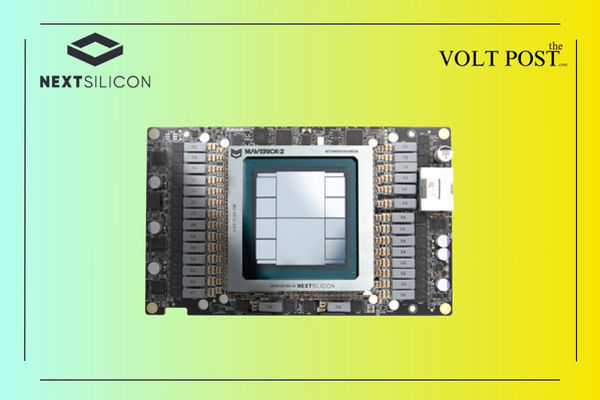
Maverick-2 has already revolutionized workloads in scientific research, HPC, and AI at dozens of client sites across the globe, including Sandia National Laboratories in its Vanguard-II supercomputer.
Maverick-2 touts to offer features that current GPUs cannot match, making it ideal for workloads that are becoming more data-intensive and algorithmically sophisticated, whether they are transformer models from today or ground-breaking algorithms from tomorrow.
By guaranteeing flexibility as workloads change, enabling unconventional acceleration for both old and emergent applications streamlines deployment and future-proofs investments.
Market Validation
Maverick-2 is said to be widely adopted by HPC pioneers and AI innovators at the forefront of scientific research, web search algorithms, social media analysis, and financial network modeling. It can handle today’s most demanding workloads with unparalleled efficiency.
Maverick-2 speeds up time-to-results, lowers operating costs, and opens up new possibilities for applications ranging from agentic AI real-time decision making or advanced reasoning models processing complex queries to modeling irregular data patterns of complex proteins for new medical treatments.
This is achieved by eliminating the need for time-consuming code rewrites or proprietary software stacks.
Leadership Performance Out-of-the-Box
Additionally, NextSilicon released detailed data on performance for Maverick-2 on a variety of important HPC benchmarks. The results were obtained using unaltered, off-the-box application code, without the need for vendor-specific optimizations, specialized programming, or drawn-out porting cycles, and they are comparable to or better than the most extensively used accelerators in the industry.
Full benchmarking results are available Here, with highlights including:
- PageRank: 10x higher graph analytics performance than leading GPUs, enabling workloads on 25GB+ graph sizes that GPUs cannot process.
- GUPS (Giga-Updates Per Second): 32.6 GUPS at 460 watts, 22x faster than CPUs and nearly 6x faster than GPUs, for high-throughput databases and AI inference.
- HPCG (High-Performance Conjugate Gradients): 600 GFLOPS at 750 watts, matching leading GPUs at half the power and delivering performance-per-watt comparable to the world’s Top 500 systems..
- STREAM: Validated full performance HBM3e for your most demanding applications.
Silicon, Not Slideware
NextSilicon also introduced Arbel, an enterprise-grade RISC-V core built on TSMC 5nm process with its own proprietary intellectual property (IP), as an investigation of future architecture. created from the bottom up to compete with AMD and Intel’s products. The test chip showcases NextSilicon’s capacity to develop top-notch intellectual property and investigate several strategic avenues, ranging from vertically integrated solutions to facilitating a more extensive RISC-V ecosystem in datacenter settings.
 Leadership Comments
“For eight decades, rigid hardware designs have forced software to adapt, with modern processors dedicating roughly 98% of silicon to overhead and just 2% to actual computation,” said Elad Raz, NextSilicon’s Founder and CEO. “Maverick-2 flips this paradigm on its head by devoting the majority of hardware real estate to compute, moving runtime overhead management to intelligent algorithms and software in real-time through our dataflow architecture.”
“We don’t just talk about innovation, we build it in silicon while others share roadmaps,” stated Raz. “As AI and HPC workloads evolve, Maverick-2’s intelligent, adaptive design ensures our customers’ investments remain future-proof while delivering unparalleled performance today. With its pioneering dataflow architecture already transforming computing, and Arbel showcasing our ability to engineer world-class, general-purpose silicon, we’re setting a bold new standard for what’s possible.”
“Over the past three years, our collaboration with NextSilicon has focused on evaluating emerging architectures for next-generation HPC workloads critical to national security,” said James H. Laros III, Senior Scientist and Vanguard program lead at Sandia National Laboratories. “The out-of-the-box HPCG performance results are impressive, showing real promise for advancing our computational capabilities without the overhead of extensive code modifications. Maverick-2’s dataflow approach demonstrates strong potential in real-world scenarios, and we’re continuing to explore its full performance envelope.”

