




A compact add-on development board dubbed NB IoT 6 Click offers reliable narrowband IoT connectivity for embedded applications. The BC65, a high-performance multi-band NB-IoT module from Quectel with low power consumption and compliance with 3GPP Release 13 and Release 14 standards, is the foundation of this new Click board from MIKROE, the embedded solutions company that significantly reduces development time by offering innovative hardware and software products based on proven standards.
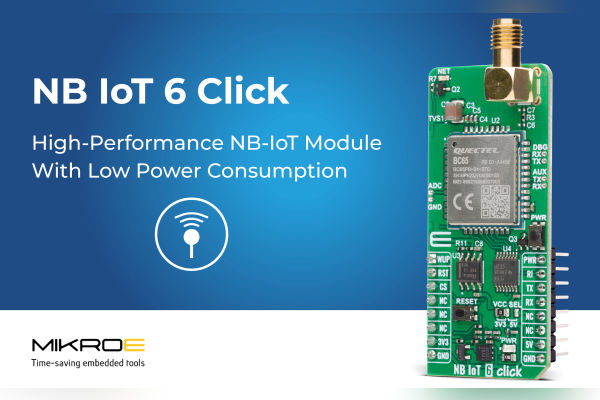
A new member of MIKROE’s 1900-strong mikroBUS™ -enabled Click board family, NB IoT 6 Click operates across a wide frequency range from approximately 700MHz to 2.2GHz, supporting LTE bands B1, B3, B5, B8, B20, and B28 with a transmission power of 23dBm ±2dB and a receiving sensitivity of –114dBm.
Alongside the main UART interface with hardware flow control, it integrates auxiliary and debug UARTs, a general-purpose 10-bit ADC channel, a SIM card holder, a network status LED, and an SMA LTE antenna connector.
Any host system that supports the mikroBUS standard can use NB IoT 6 Click since it is completely compatible with the mikroBUS socket. It includes the open-source mikroSDK libraries, which provide unmatched adaptability for testing and personalization.
Click boards adhere to a MIKROE-invented modular prototype add-on board standard that transforms how users enhance development boards with new features. Design engineers can quickly switch out peripherals with click boards, which saves months of development time.
To enable hundreds of Click board to be connected to the microcontroller or microprocessor, the mikroBUS uniform connection interface allows designers to connect any Click board to a main board instantly.
The company releases a new Click board nearly every day at 10am, and many leading microcontroller companies including Microchip, NXP, Infineon, Dialog, STM, Analog Devices, Renesas, and Toshiba now include the mikroBUS™ socket on their development boards.
 Leadership Comments
Comments Nebojsa Matic, CEO of MIKROE: “This new Click board enables enable designers to prove that they can connect smart meters, asset trackers, and sensors over long distances, then begin full product development immediately without having to learn new tools or pay for expensive development kits.” Other applications include smart parking, wearables, smart city solutions, agriculture, environmental monitoring and home appliances that requires wide-area coverage and stable communication.

