





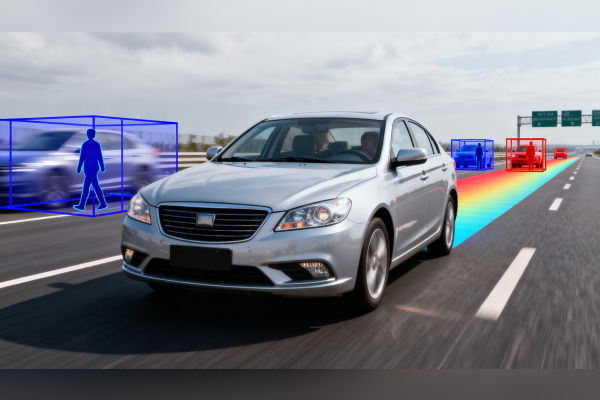
mmWave radar sensors operate in the 30-300 GHz range, transmitting short-wavelength electromagnetic waves to detect objects via reflections, enabling precise measurement of range, velocity, and angle even in harsh conditions like fog or darkness. These sensors excel in automotive advanced driver-assistance systems (ADAS), industrial automation, and IoT due to their high resolution and low power use.?
Core Fundamentals
mmWave radar uses frequency-modulated continuous wave (FMCW) technology, where a transmitted chirp signal a frequency-sweeping waveform—mixes with the reflected echo to produce an intermediate-frequency (IF) signal.
Range derives from the time delay or beat frequency of this IF signal, calculated as distance = (chirp slope × beat frequency) / (2 × speed of light); velocity comes from phase shifts across multiple chirps, with Doppler shift given by V = ??? / (4?Tc), where ? is wavelength and Tc is chirp duration.
Angle of arrival (AoA) relies on phase differences from antenna arrays, supporting multi-target tracking without light dependency or weather interference.?
Key strengths include narrow beamwidth for high angular accuracy (under 1°), large bandwidth for sub-meter resolution, and robustness against stealth materials or clutter. Limitations involve higher costs than ultrasonic sensors and multipath challenges in dense environments, addressed via advanced signal processing.?
 Technical Architectures
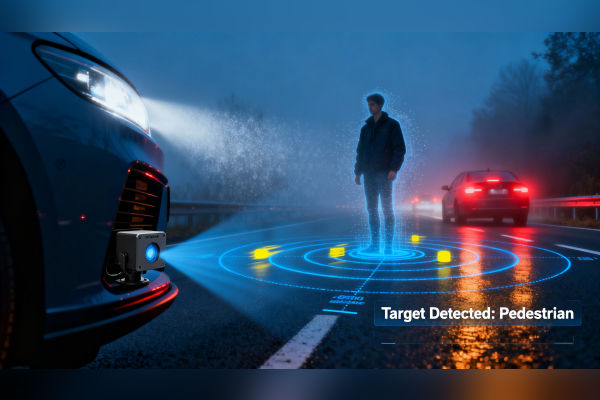
Modern mmWave systems integrate a complete radar-on-chip (SoC) with transmitter (TX), receiver (RX), antennas-in-package (AIP), DSP, and MCU, minimizing RF design hurdles. Core components feature multiple TX/RX channels (e.g., 3TX/4RX) for MIMO beamforming, enabling AoA via phase-shifted chirps; FMCW chirps ramp at speeds up to 400 MHz/µs for >5 GHz bandwidth.?
Signal flow starts with chirp generation, amplification, and transmission; RX captures echoes, downconverts to IF, then DSP applies FFT for range-Doppler maps and CFAR detection.
Edge AI integration, like TI’s Edge AI Studio with PyTorch models, adds classification for human detection or gestures. Architectures scale from 60 GHz low-power IoT (e.g., <5mW duty-cycled) to 77 GHz automotive high-res (up to 300m range).?
| Parameter | 60 GHz (IoT/Industrial) | 77 GHz (Automotive) |
| Bandwidth | >5 GHz | 4-5 GHz |
| Power | <5mW | 1-5W |
| Range | 10-50m | 100-300m |
| Channels | 2TX/4RX | 4TX/8RX+ |
 Leading 5 Companies and Flagship Products
- Texas Instruments‘ integrated 60/77 GHz SoCs for ADAS and industrial sensing. Flagship AWR1843 and AWR294x offer <5cm resolution, 200m+ detection, and NCAP-compliant child presence via low-power FMCW.?
- Infineon provides 24/60/77 GHz sensors with AIP for gesture and vital sign monitoring. BGT60TR13C stands out for IoT, delivering >5GHz bandwidth, high SNR, and <5mW in a compact 6.5x5mm package.?
- NXP focuses on high-res 77 GHz for imaging radar. The MR3003 transceiver and S32R45 processor enable sub-degree resolution with 64x compute boost via MIMO and super-res algorithms.?
- Bosch delivers scalable 77 GHz SoCs for SAE Level 2+ ADAS. SX601/SX600 integrate 4TX/4RX, AI DSP, and 22nm RF-CMOS for 30% range gains (250m+), dynamic chirps, and CAN XL interfaces.?
- Continental produces mass-market radars, hitting 200 million units. ARS441 and fifth-gen 4D imaging radars achieve 300m range, supporting parking aids to full autonomy with compact, affordable designs.?

