





From Satellite Systems to Mars Rovers, MCUs Drive Modern Space Exploration
The Volt Post – All Rights Reserved
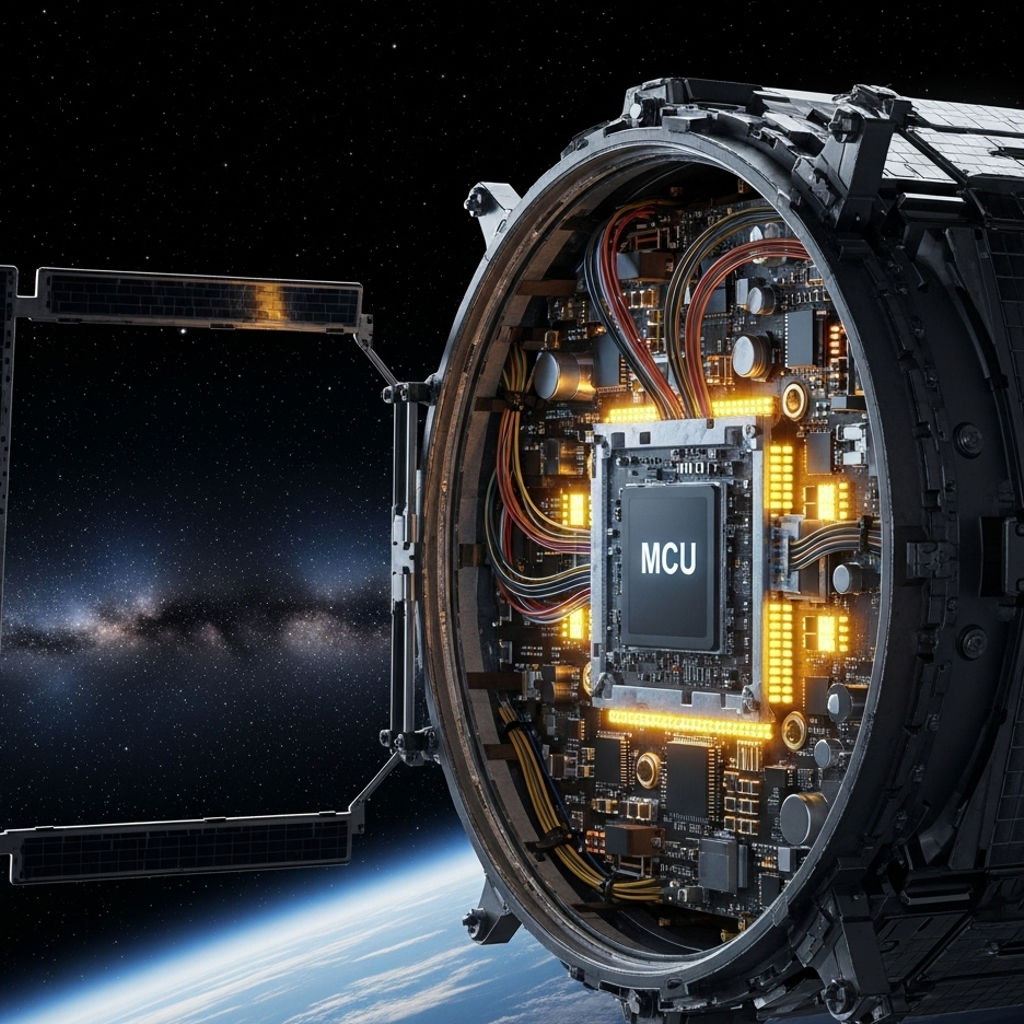
In the silent vacuum of space, where machines must endure harsh radiation, extreme temperatures, and total isolation, every electronic decision must be precise, reliable, and power-efficient. At the heart of these intelligent space systems lies a surprisingly humble component — the microcontroller unit, or MCU.
Often overlooked outside engineering circles, MCUs play an indispensable role in the operation, control, and autonomy of virtually every spacecraft, satellite, and exploratory robot sent beyond Earth’s atmosphere.
What Is an MCU? Why Does It Matter in Space?
A microcontroller is a compact integrated circuit designed to govern a specific operation in an embedded system.
Unlike general-purpose CPUs, MCUs are optimized for control-oriented tasks with onboard memory, I/O ports, timers, and analog peripherals all tightly packed into a small form factor. In space missions, where weight, energy, and reliability are paramount, MCUs shine as efficient and resilient solutions.
From the International Space Station‘s environmental monitoring systems to deep-space probes like Voyager and Mars rovers like Perseverance, MCUs handle critical systems such as:
- Thermal control
- Telemetry collection
- Actuator/motor management
- Power distribution
- Fault detection and recovery
- Data acquisition from scientific instruments
They serve as the brain behind control loops, health monitoring systems, and robotic mechanisms — making them the silent operators of our interstellar ambitions.
Key MCU Applications in Space Missions
Satellite Subsystems
Whether it’s a small CubeSat or a large geosynchronous satellite, MCUs power key subsystems like:
- Attitude Determination and Control Systems (ADCS): Adjusting orientation via gyroscopes, reaction wheels, and magnetorquers.
- On-Board Data Handling (OBDH): Collecting and routing sensor data, managing command execution.
- Communication Modules: Managing RF transceivers and modulating telemetry signals.
- Thermal Management: Activating heaters or cooling systems based on sensor feedback.
Radiation-hardened MCUs such as those from Microchip’s SAMRH71 or STMicroelectronics’ STM32 in Rad-Hard packaging are built to endure cosmic rays and single-event upsets (SEUs), ensuring reliability in orbit.
Planetary Exploration Rovers and Landers
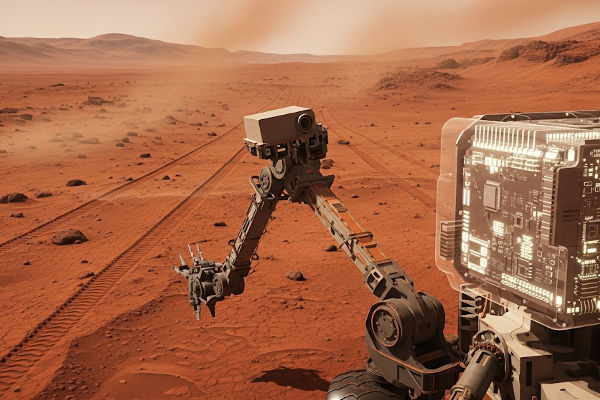
On Martian soil, robotic explorers like NASA’s Perseverance and Curiosity rely on MCUs to:
- Interface with sensors for terrain mapping and environmental data collection.
- Control robotic arms and wheel motors.
- Coordinate onboard power systems.
- Manage scientific payloads.
In such missions, MCUs are often tasked with autonomous decision-making, especially when real-time communication with Earth is impossible due to distance and signal latency.
The Volt Post – All Rights Reserved
Launch Vehicle Electronics
Modern launch systems, including India’s PSLV and SpaceX’s Falcon rockets, embed MCUs in their:
- Flight computers
- Inertial navigation systems
- Stage separation logic
- Telemetry acquisition units
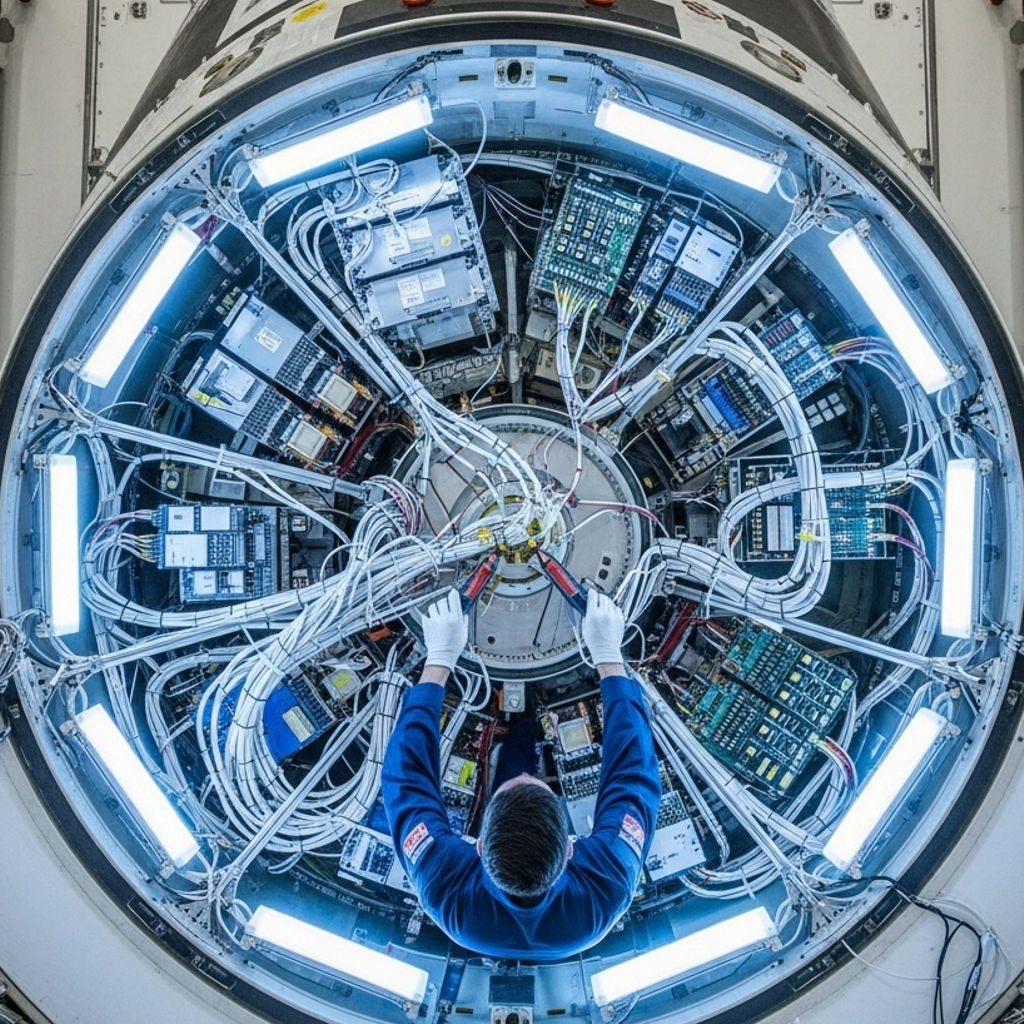
They perform real-time data processing and control — ensuring mission success during critical phases like ignition, ascent, and orbit insertion.
Life Support and Environmental Systems
On crewed missions like those aboard the ISS or the upcoming Artemis lunar habitats, MCUs regulate:
- CO? scrubbing units
- Air circulation
- Water purification systems
- Cabin temperature and pressure
These systems must work flawlessly under all circumstances, demanding MCUs with redundancy, fail-safe protocols, and long operational lifespans.
Radiation Hardening: A Critical Differentiator
Earth’s magnetic field shields us from a large portion of cosmic radiation. Spacecraft, however, are exposed to heavy ionizing radiation and solar flares that can cause logic flips or physical damage in semiconductor devices.
To address this, aerospace MCUs undergo radiation hardening by design (RHBD) and radiation hardening by process (RHBP). They are tested for Total Ionizing Dose (TID) and Single Event Latch-up (SEL) resistance.
Key players in rad-hard MCUs include:
- Microchip Technology (Atmel heritage): Trusted by NASA and ESA.
- STMicroelectronics: Offers robust 32-bit MCUs for space-grade systems.
- Cobham (now CAES): Legacy provider of space electronics for defense and commercial satellites.
“Before the roar of liftoff, MCUs synchronize every subsystem aboard the launch vehicle.
The Volt Post – All Rights Reserved
Case Study: Microchip SAMRH71 in LEO and Deep Space
The SAMRH71, a 32-bit MCU built on ARM Cortex-M7, is gaining traction for use in Low Earth Orbit and beyond.
With real-time capabilities, ECC-protected memory, and fault detection mechanisms, it’s used in satellites and on-board navigation systems where deterministic performance is critical.
It supports SpaceWire and CAN interfaces — vital for modular satellite architectures — and offers a strong software ecosystem compliant with space standards like ECSS and DO-254.
The Push Toward Autonomous and AI-Powered Spacecraft
The evolution of microcontrollers is being shaped by the growing need for autonomous navigation, AI-based decision systems, and real-time responsiveness in space.
This is paving the way for hybrid systems where MCUs work alongside more powerful processors or FPGAs to perform:
- AI-based anomaly detection in satellite telemetry.
- Terrain-aware path planning on planetary surfaces.
- Distributed sensor fusion in satellite swarms.
Emerging MCUs from companies like Renesas, NXP, and Texas Instruments now include AI acceleration features, enabling edge processing in space-based applications — a domain previously exclusive to ground-based systems.
MCUs in the Era of Commercial Spaceflight and Moon Bases
As commercial ventures like SpaceX, Blue Origin, and India’s Skyroot Aerospace build reusable launchers and modular space stations, MCUs will be at the core of scalable, modular control systems.
These microcontrollers must now adapt to:
- Longer mission durations
- Greater data throughput
- Seamless integration with AI chips and FPGA arrays
Moreover, the rise of lunar habitats, asteroid mining missions, and interplanetary cargo logistics will require a new class of microcontrollers that can operate in resource-constrained environments while supporting high-level autonomy and advanced diagnostics.
Tiny Chips, Colossal Impact
Microcontrollers may be physically small, but their influence on space technology is immense. They embody the delicate balance of power efficiency, fault tolerance, and intelligence needed for successful operations beyond Earth.

