





Key trends and changes in the industrial network market have been revealed in the Annual HMS Networks Report. The market saw a minor downturn in 2024 following an extraordinary uptick in 2023, with a drop of roughly 10–11% in newly installed nodes. The main causes of this decline include a more difficult economic climate, persistent uncertainty, and surplus production capacity in highly automated industries like manufacturing and automobiles, especially in Europe.
While older fieldbus technologies are rapidly dropping, the analysis reveals that Industrial Ethernet is still solidifying its position despite the general downturn.
The need for serial-based fieldbus solutions has been maintained during the last two years due to shortages in electronic components, which forced businesses to use any available technology.
However, the emphasis has changed toward more affordable and scalable Ethernet-based communication due to the increased availability of components and growing economic pressures.
According to the Annual HMS Networks Report 2025, HMS estimates that the industrial network market will continue to expand, with a total market increase of +7.7% during the following five years. A ramp-up is forecast in the upcoming years, confirming the continuous relevance of network connectivity in factories, even though 2025 is predicted to be below this average due to present market conditions.
Ethernet-Based Networks Now Represent 76% of New Installations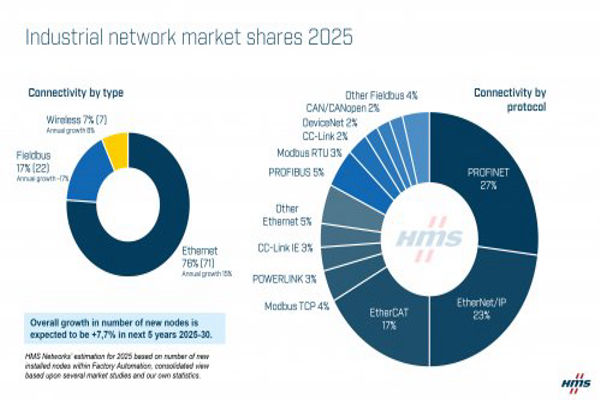
The Annual HMS Networks Report shows that Ethernet-based industrial networks now account for 76% of new nodes, up from 71% in 2024.
Leading the Ethernet Pack:
• PROFINET strengthens its lead at 27% (up from 23%)
• EtherNet/IP follows at 23% (up from 21%)
• EtherCAT continues a strong trajectory at 17% (up from 16%)
• Modbus TCP holds steady at 4%
• POWERLINK, CC-Link IE, and other Ethernet networks remain stable, with slight adjustments
Fieldbus technologies now represent just 17% of new nodes, down from 22% in 2024.
Within Fieldbus:
• PROFIBUS remains the largest but drops to 5% (from 7%)
• DeviceNet, CC-Link, and Modbus RTU each decline by 1 percentage point
• CAN/CANopen holds steady at 2%
• Other Fieldbus protocols collectively make up 4%
Wireless Remains Steady a 7%
7% of newly installed nodes are connected by wireless technologies, which is unchanged from 2024. For use cases that call for mobility, flexible networking, or hard-to-reach locations, such autonomous guided vehicles (AGVs), mobile industrial equipment, and upgrading legacy systems, wireless remains a crucial addition to non-real-time vital communications.
Although 5G wireless technology is now being used for mobile telephony, industrial automation is still adopting it slowly. This is because of the difficulties in obtaining reasonably priced real-time performance in cellular chips, the intricacy of infrastructure management, and the high implementation costs.
Notwithstanding these obstacles, the technology has enormous possibilities for the future of industrial communication, and early industrial deployments are already under way, especially in Asia.
Regional insights
- Europe: Strong adoption of PROFINET and EtherCAT, with increasing interest in new infrastructure technologies like APL (Advanced Physical Layer) to enable Ethernet communication for process automation applications, and SPE (Single Pair Ethernet) for Ethernet communication up to sensors.
- North America: EtherNet/IP remains the leading protocol in North America, but adoption of smart device-friendly technologies like IO-Link, APL, and SPE is clearly growing, with strong market momentum expected in the coming years.
- Asia: PROFINET and EtherCAT are both growing in the Chinese market, while CC-Link IE, the first industrial protocol with TSN mechanism, maintains a strong regional foothold.
HMS Networks’ Perspective
“This year’s data clearly confirms the ongoing shift from traditional fieldbuses to Industrial Ethernet. It’s a transition driven by the need for more modern network capabilities in today’s automation systems,” says Magnus Jansson, VP Marketing at HMS Networks. “While Industrial Ethernet is now well-established, we still see strong growth due to an appetite for more information and the digitalization of the industry. The Ethernet infrastructure also paves the way for further innovation toward gigabit Ethernet, TSN, Single Pair Ethernet, and OT/IT convergence.”
The average growth expectation over the coming 5 years is estimated at 7.7%, despite the short-term political and economic uncertainties and upcoming cybersecurity regulations that will force automation companies to rethink the way they connect automation systems.
About the study
The HMS Networks analysis is based on a combination of market insights, internal data, and input from key stakeholders in the industrial automation industry. The study focuses on newly installed nodes in factory automation worldwide, each node being a device or machine connected to an industrial control network.

