





Kneron has introduced the Edge AI Chip – KL1140, a next-generation neural processing unit (NPU) designed to run large language models (LLMs) directly on edge devices, slashing inference costs by 10 times and boosting energy efficiency threefold compared to cloud alternatives.
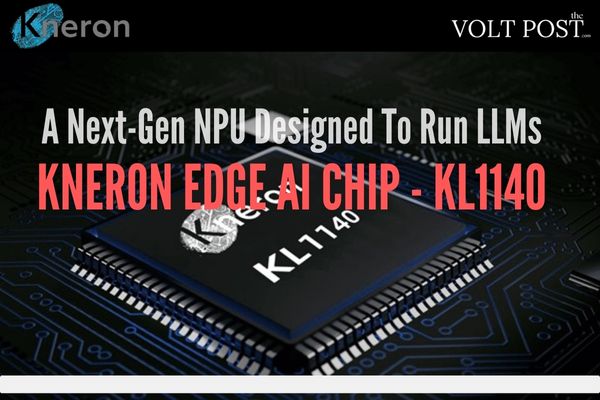
This San Diego-based innovator claims the KL1140 Edge AI Chip pioneers on-device execution of full Mamba and transformer networks, enabling four cascaded chips to handle models up to 120 billion parameters—matching GPU performance at a fraction of the power draw.
Independent UC Berkeley benchmarks validate its edge AI supremacy, addressing surging data center energy needs projected to hit 175GW by 2035.
 Key Features of The New Edge AI Chip Includes:
- Reduces inference costs by 10 times compared to cloud-based AI solutions
- Delivers 3 times higher energy efficiency versus cloud alternatives
- Supports on-device execution of large language models up to 120 billion parameters using four cascaded chips
- Matches GPU-level performance while consuming significantly lower power
- Validated by independent UC Berkeley benchmarks for edge AI performance
- Enables real-time natural language processing, voice recognition, computer vision, and robotics at the edge
- Facilitates offline AI applications without relying on cloud connectivity
- Designed for sustainable and energy-efficient AI computing at the edge
Targeted at real-time natural language processing, voice recognition, computer vision, and robotics, the chip supports offline applications like autonomous security robots interpreting commands, in-vehicle decision systems without network dependency, on-premises enterprise assistants, and factory-floor smart machinery.
Leadership Comments
“The unsustainable rise in cloud AI costs and power demands requires a shift to edge computing,” stated Albert Liu, Founder and CEO of Kneron. “KL1140 unlocks powerful LLMs for everyday devices, creating secure, lag-free intelligence previously confined to data centers.”
“This chip marks a pivotal advance toward sustainable, high-performance AI,” Liu added. “It empowers developers to build previously impossible edge applications.”

