





As vehicles evolve into connected, intelligent, and autonomous systems, the demand for powerful computing architectures is rapidly increasing. In a major milestone, 28 research partners from industry and academia have introduced a Germany-made automotive supercomputer developed under the Mannheim-CeCaS (Central Car Server) project.
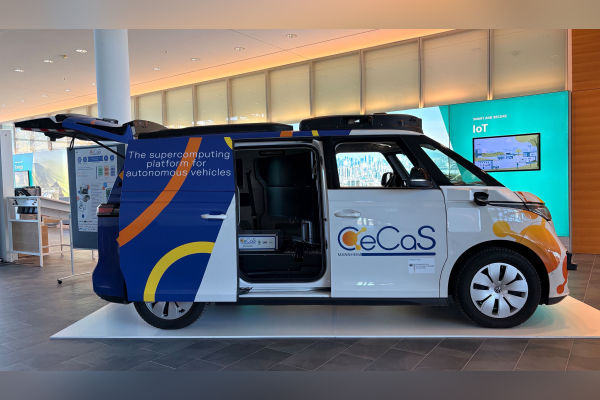
Led by Infineon Technologies, the three-year project created a central computing platform that meets the highest safety and reliability standards.
Supported by the German Federal Ministry of Research, Technology and Space (BMFTR) with funding of 88.2 million euros, Mannheim-CeCaS marks one of the largest national initiatives for the country’s automotive future.
The demonstrator was successfully showcased in Munich, fully integrated within an electric vehicle.
High-Performance Automotive Computing Platform
The Mannheim-CeCaS project aimed to build a real-time capable supercomputer supporting Levels 3 to 5 of autonomous driving.
The consortium focused on processor design, interface development, and system architecture, combining them with a flexible software environment optimized for AI algorithms used in modern vehicles.
These innovations pave the way for safer and more efficient automated mobility.
Centralized and Modular Vehicle Intelligence
Rather than relying on numerous independent electronic control units, the project consolidated vehicle intelligence into a centralized platform.
This approach minimizes system complexity and boosts operational efficiency while allowing easy adaptation to new features.
The modular framework also supports seamless upgrades reducing development time for future models across various performance segments.
 Zonal Architecture for Efficiency and Safety
The Mannheim-CeCaS demonstrator manages a wide range of systems, from driving-critical functions like braking and transmission to sensors, HVAC units, and infotainment.
The Ethernet-based zonal architecture allows real-time communication between modules while significantly reducing cabling requirements cutting both weight and energy consumption, which extends EV range.
This architecture also supports over-the-air (OTA) updates, enabling the vehicle’s software to stay current without physical maintenance visits
Rapid Prototyping and Future Potential
Thanks to a cost-optimized rapid prototyping approach, the research team implemented the zonal demonstrator within just nine months.
The design is prepared for full automotive qualification, with applications extending to modular chiplet technologies and RISC-V-based processors, reinforcing its relevance to next-generation computing solutions.
Collaboration Driving Innovation
Over three years, the Mannheim-CeCaS initiative united 28 partners from across Germany, including technology leaders, research institutes, and universities. Co-funded by the BMFTR’s “Future Fund for the Automotive Industry,” the project showcases Germany’s commitment to advancing safe, scalable, and sustainable mobility technologies.
Key partners included CARIAD SE, Robert Bosch GmbH, ZF Friedrichshafen AG, Fraunhofer Institutes, Swissbit, Hella, AVL Software and Functions, and multiple research institutions such as KIT, TUM, and HM Hochschule München.
Leadership Comments
“The results of the Mannheim-CeCaS project are a significant step towards the mobility of the future – this is where research and innovation meet the road,” says Frank Badstübner, spokesperson for the Mannheim-CeCaS project management team, Infineon Technologies AG, adding: “The energy and cost-efficient high-performance computing platform developed jointly in the consortium is standardized, modular and scalable. This demonstrates impressively how we, together with excellent partners from industry and science, contribute to the innovative strength of the German automotive industry in global competition.”

