





Bengaluru-based researchers at the Indian Institute of Science (IISc) have pioneered a game-changing redesign of GaN Transistors, paving the way for widespread adoption in electric vehicles (EVs), data centers, and renewable energy setups.
GaN transistors promise to outpace traditional silicon by slashing energy losses and shrinking power converters by nearly 3x, but reliability issues have slowed commercial rollout.
Current p-GaN gate designs trigger at just 1.5-2V and leak beyond 5-6V, posing risks in high-stakes applications.
Unlocking Reliable High-Voltage Performance
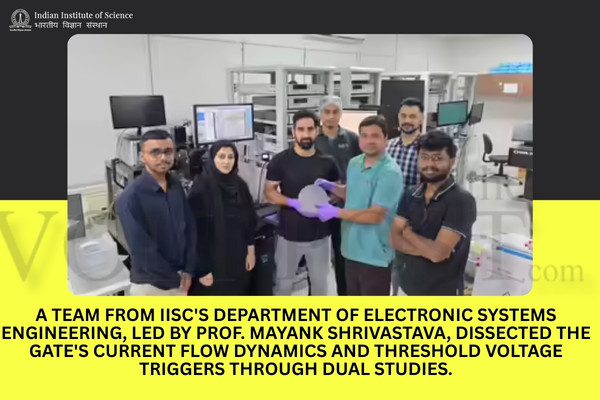
A team from IISc’s Department of Electronic Systems Engineering, led by Prof. Mayank Shrivastava, dissected the gate’s current flow dynamics and threshold voltage triggers through dual studies.
They pinpointed how partial depletion in the p-GaN layer creates leakage paths from charge buildup at critical interfaces, causing premature activation. By engineering metal gate stacks, the group slashed leakage by 10,000x, boosted threshold stability, and hit gate breakdown voltages of 15.5V.
In phase two, a novel aluminum-titanium oxide integrated stack now patented prevents charge injection, mimicking silicon MOSFETs with thresholds over 4V, superior control, and enhanced durability.
Real-World Impact for Power Electronics
Lead doctoral researcher Rasik Rashid Malik highlighted the potential: “This reliability leap fast-tracks GaN into EV chargers, server PSUs, and solar inverters where downtime isn’t an option.”
The redesign addresses a core bottleneck, enabling compact, efficient systems for India’s booming EV ecosystem and green data centers.
IISc plans to scale via government funding and industry collaborations.
 Prof. Shrivastava emphasized: “Pairing high thresholds with ultra-low leakage unlocks GaN’s full promise, solving a decade-old electronics hurdle and fueling sector-wide transformation.”
Key Comments
Prof. Mayank Shrivastava: “We’ve decoded leakage physics to deliver robust, high-voltage GaN—essential for EVs and renewables.”
Rasik Rashid Malik: “From lab to fab, this paves GaN’s road to everyday power apps.”

