





India’s Defence Research and Development Organisation (DRDO) has marked a pivotal advancement in self-reliant defence technology by successfully developing indigenous GaN MMICs.
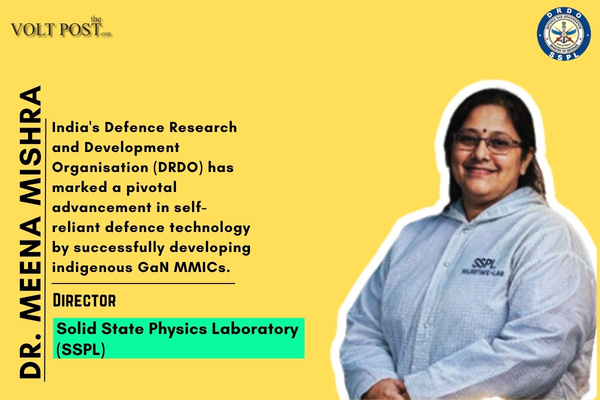
Led by Dr. Meena Mishra, Director of the Solid State Physics Laboratory (SSPL), the achievement positions India among an elite cadre of nations including the US, France, Russia, Germany, South Korea, and China capable of designing and fabricating these high-performance chips domestically.
Unlike traditional silicon-based semiconductors, GaN MMICs leverage compound materials for superior electron mobility, enabling ultra-fast switching speeds up to 300 times faster than silicon equivalents while delivering exceptional power output from compact footprints.
A single GaN chip, measuring just 3.5 mm x 3 mm, can generate 30 watts of power, operate reliably at temperatures exceeding 1,000°C, and maintain signal integrity under high voltages with minimal losses.
These attributes make them indispensable for next-generation radars, electronic warfare systems, missile guidance, fighter aircraft avionics, naval platforms, and advanced drones.
Technical Edge Over Conventional Semiconductors
GaN technology excels in high-frequency, high-power RF applications due to its wide bandgap (3.4 eV compared to silicon’s 1.1 eV), which supports higher breakdown voltages and thermal conductivity.
SSPL and the Gallium Arsenide Enabling Technology Centre (GAETEC) in Hyderabad collaborated to produce over 30 GaN chip variants across frequency bands, optimized for 5G communications, satellite links, and sensor arrays in harsh environments.
Early prototypes cleared rigorous functionality tests in 2023, with scaled production now supporting DRDO and ISRO missions, including RISAT-series radar satellites that deploy thousands of indigenous GaAs and GaN MMICs.
This indigenous capability stems from years of persistent R&D, accelerated by technology denial during the Rafale deal negotiations and inspired by visionaries like Dr. A.P.J. Abdul Kalam. While India mastered GaAs chips in the 1990s, GaN’s complexity requiring ultra-pure precursor gases and specialized reactors demanded breakthroughs in epitaxial growth and fabrication processes.
Driving India’s Defence Ecosystem
The global GaN market, valued at $3.5-4.1 billion in 2025, is projected to surge to $10-12 billion by 2030, underscoring the strategic stakes.
For India, this reduces import vulnerabilities that could halt critical programs overnight, bolstering Atmanirbhar Bharat in deep-tech domains.
DRDO’s GaN HEMTs already scale to 150W in some configurations, paving the way for compact, efficient active electronically scanned arrays (AESAs) in future radars and jammers.
Comments from DRDO Leadership
Dr. Meena Mishra emphasized the transformative potential, “The dough is ready; India can now bake any bread it wants. This technology transfer is available at nominal cost to Indian industries, fostering GaN foundries and economic growth.”
Smt. Suma Varughese, Director General (Micro Electronic Devices and Computational Systems & Cyber Security), DRDO, added, “Self-reliance in compound semiconductors is the bedrock of sovereign capability. An embargo can arrive overnight—our GaN success is a launchpad for leapfrog technologies in defence and beyond.”
A senior ISRO official noted, “GAETEC-fabricated MMICs power RISAT radars and interplanetary missions, marking a major milestone in semiconductor sovereignty.”
What Expert’s Think?
Challenges remain, including indigenous production of high-purity gases (99.99999% purity) and multi-crore reactors currently sourced abroad. DRDO is channeling projects to academia and  industry for localization, with technology transfer enabling private foundries.
Experts like Prof. Ankush Bag from IIT Guwahati predict regional GaN dominance, cost reductions via commercial spillover (e.g., 5G chargers), and monolithic integration for minimized size, weight, power, and cost (SWaP-C).
This milestone not only nurture India’s military edge but signals maturity in compound semiconductors, aligning with national goals for a $1 lakh crore ecosystem by decade’s end.
As defence expos in 2025 highlighted, GaN is set to redefine high-stakes electronics, from battlefield sensors to space-grade systems.
To Know More About Solid State Physics Laboratory: CLICK HERE

