





- Frederik Dostal, Power Management Expert
New advances in the linear regulator field generated the first digital LDO. Such devices will help to generate more advanced systems in the RF field, in instrumentation, and in medical applications.
Abstract
There is a new product type in the industry, the digital low dropout (LDO) linear regulator. It offers telemetry and adjustability of a linear power supply in a very small footprint. Such solutions are used in ultralow noise applications in the RF and instrumentation field.
Introduction
Linear regulators are simple voltage converters in which a higher input voltage can be converted into a lower output voltage. They behave like a dynamic resistor, which always adjusts to exactly the value that is necessary to keep a set output voltage constant at a certain current flow.
Due to the availability of many different, easy to use, switch-mode power converters, which have a much higher efficiency in most applications, linear regulators are used less and less. However, there is one use case where linear regulators are still very important. This is in the filtering of voltages generated by switching regulators.
Figure 1 shows an example. The switch-mode power supply (SMPS) generates an output voltage with a technology-related voltage ripple. A linear regulator usually has a good power supply rejection ratio (PSRR). This indicates how well a component can reduce interference at different frequencies.

For the application of a linear regulator as shown in Figure 1, a special type of linear regulator has been developed. This is called an ultralow noise linear regulator. In addition to high PSRR values, these linear regulators generate only very low noise, especially in the low frequency band between 1 Hz and 100 kHz.
Typical use cases for such low noise power supplies include high and low bandwidth precision circuits such as phase locked loops (PLLs), voltage-controlled oscillators (VCOs), mixers, low noise amplifiers (LNAs), and power amplifiers (PAs), as well as in high accuracy instrumentation applications.
For some of these implementations, it is helpful to be able to detect the state of the power supply. The system could use information about the input voltage, output voltage, load current, and temperature of the linear regulator to confirm proper operation of the circuit. There is a new solution available for these applications, the digital LDO.
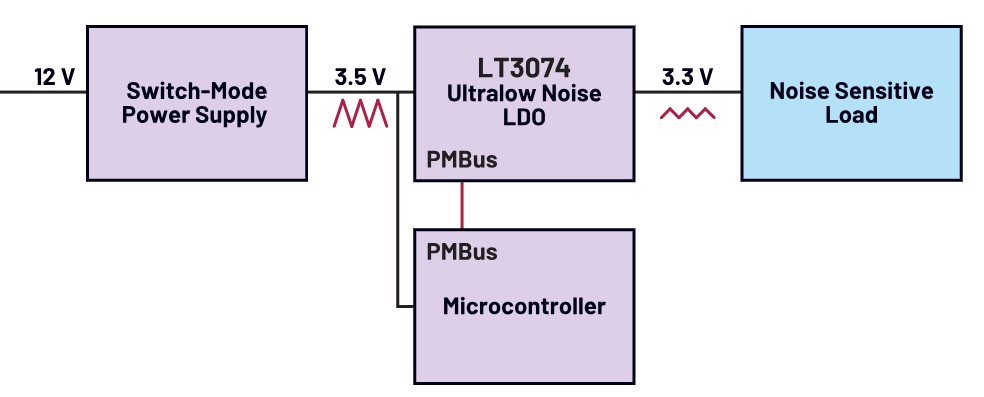
A digital LDO is designed like a conventional ultralow noise LDO, but with a digital interface, PMBus®. Figure 2 shows a system similar to the one in Figure 1, but with the LT3074, a digital LDO.
The product category of a digital LDO is new. In the past, digital interface devices, such as the LTC2972, could be combined with an ultralow noise linear regulator, such as the LT3041. However, this requires an increased footprint and makes circuit design more complex.
With a new digital LDO, such as the LT3074, everything is combined in one IC. This integrated circuit is a linear regulator with a digital interface for setting parameters of the LDO, such as the current limit, output voltage, and telemetry to pull information about the operating state.
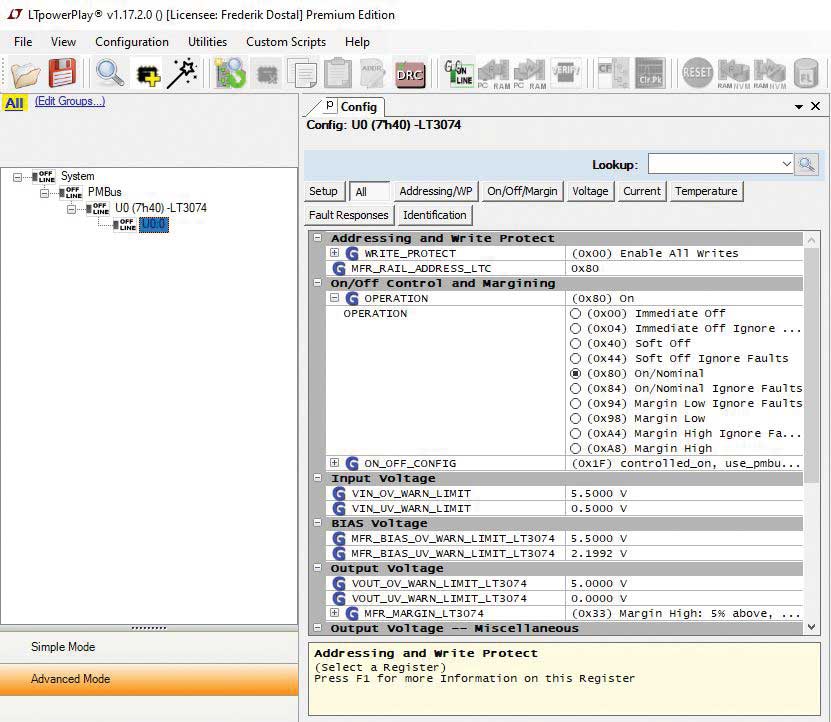
In the system, for example, a microcontroller communicates with the LDO, as shown in Figure 2. LTpowerPlay® can be used for evaluation. This is a free software that can be downloaded from analog.com. It is a graphical user interface that communicates with the digital LDO via a USB to a PMBus interface.
Finally, the question arises as to why this technology—that is, the merging of a digital connection to an ultralow noise LDO—was not available in the past.
This is due to the difficulty of combining digital, clocked circuit parts with the ultralow noise technology of an LDO without interference from the digital part to the analog part of the integrated circuit. With the LT3074, which has an rms noise of 1.2 ?V rms (10 Hz to 100 kHz), this combination has been achieved.
Conclusion
New advances in the linear regulator field generated the first digital LDO. Such devices will help to generate more advanced systems in the RF field, in instrumentation, and in medical applications.
Systems will be more robust due to the integrated telemetry feature, will be more feature-rich due to the adjustability of parameters, and will be smaller due to the high level of integration.
About the Author
Frederik Dostal is a power management expert with more than 20 years of experience in this industry. After his studies of microelectronics at the University of Erlangen, Germany, he joined National Semiconductor in 2001, where he worked as a field applications engineer, gaining experience in implementing power management solutions in customer projects.
During his time at National, he also spent four years in Phoenix, Arizona (U.S.A.), working on switch-mode power supplies as an applications engineer.
In 2009, he joined Analog Devices, where he has since held a variety of positions working for the product line and European technical support, and currently brings his broad design and application knowledge as a power management expert. Frederik works in the ADI office in Munich, Germany.

