





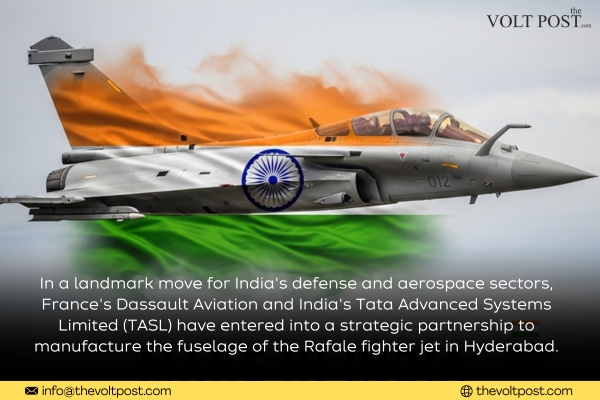
In a landmark move for India’s defense and aerospace sectors, France’s Dassault Aviation and India’s Tata Advanced Systems Limited (TASL) have entered into a strategic partnership to manufacture the fuselage of the Rafale fighter jet in Hyderabad.
© 2025 The Volt Post. All rights reserved.
Image created by The Volt Post for editorial use. Unauthorized reproduction or distribution is prohibited. For permissions, contact info@thevoltpost.com.
This collaboration marks the first time that critical components of the Rafale will be produced outside France, aligning with India’s ‘Make in India’ and ‘Atmanirbhar Bharat’ initiatives.
Strengthening India’s Defense Manufacturing Capabilities
The agreement between Dassault and TASL involves four Production Transfer Agreements, enabling the production of Rafale fuselages at TASL’s Hyderabad facility. This development is a significant step towards bolstering India’s indigenous defense manufacturing capabilities and reducing reliance on foreign imports.
The Hyderabad facility is expected to commence production in the fiscal year 2028, with an initial output of two fuselages per month. These fuselages will cater to both Indian and global markets, positioning India as a key player in the global aerospace supply chain.
Leaders’ Perspectives on the Collaboration
Indian Prime Minister Narendra Modi hailed the partnership as a testament to India’s growing capabilities in defense manufacturing. “This collaboration between Dassault and Tata is a significant milestone in our journey towards self-reliance in defense production,” he stated.
Eric Trappier, CEO of Dassault Aviation, expressed confidence in the partnership, emphasizing the strategic importance of India in Dassault’s global operations. “India’s robust industrial base and skilled workforce make it an ideal partner for our expansion plans,” he noted.
Economic and Strategic Implications
This collaboration is expected to have far-reaching economic and strategic implications:
-
Job Creation: The establishment of the manufacturing facility in Hyderabad is anticipated to generate significant employment opportunities, both directly and indirectly, in the region.
-
Technology Transfer: The partnership will facilitate the transfer of advanced aerospace manufacturing technologies to India, enhancing the country’s technical expertise.
-
Export Potential: With the production of Rafale components in India, there is potential for increased exports, contributing to India’s goal of becoming a global defense manufacturing hub.
Aligning with ‘Make in India’ and ‘Atmanirbhar Bharat’
The Dassault-Tata partnership aligns seamlessly with the Indian government’s ‘Make in India’ and ‘Atmanirbhar Bharat’ initiatives, which aim to promote indigenous manufacturing and reduce dependence on foreign imports.
By producing critical components of the Rafale fighter jet domestically, India is taking a significant step towards achieving self-reliance in defense production.
© 2025 The Volt Post. All rights reserved.
Image created by The Volt Post for editorial use. Unauthorized reproduction or distribution is prohibited. For permissions, contact info@thevoltpost.com.
Future Prospects and Developments
Looking ahead, the collaboration between Dassault and Tata is poised to pave the way for further developments in India’s defense sector:
-
Expanded Production: There are discussions about establishing a full assembly line for the Rafale F5 variant in India, which would further enhance the country’s manufacturing capabilities.
-
Maintenance and Support Facilities: In addition to manufacturing, there are plans to set up maintenance, repair, and overhaul (MRO) facilities for Rafale jets in India, ensuring comprehensive support for the aircraft.
-
Collaborations with Other Global Players: The success of the Dassault-Tata partnership could serve as a model for future collaborations between Indian companies and global defense manufacturers.

