





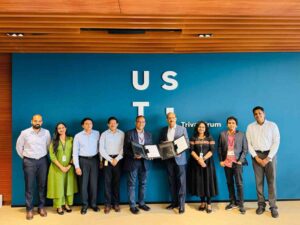
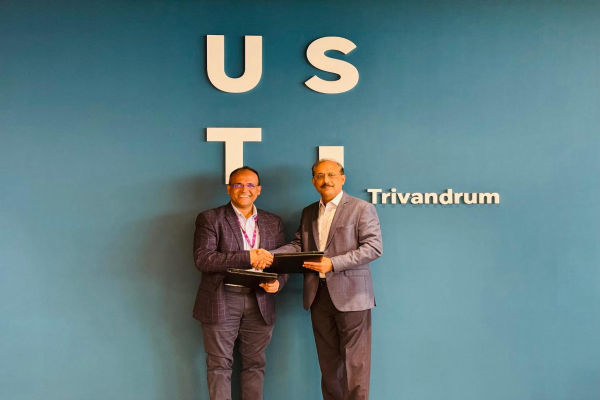
In order to create an academic-industry partnership, UST has inked a Memorandum of Understanding (MoU) with Birla Institute of Technology and Science (BITS) Pilani, one of India’s top universities. The Memorandum of Understanding, which was formally signed at UST’s Thiruvananthapuram Campus, describes a multifaceted collaboration between UST and BITS Pilani that will foster innovation, talent development, and collaborative research to connect academia and industry and develop solutions that have practical applications.
Advanced research and co-creation in cutting-edge fields such photonics, quantum computing, VLSI, humanoid robotics, artificial intelligence, and medical technology are the partnership’s key goals. Under the combined direction of BITS Pilani’s academic leadership and UST’s engineering expertise, patents, Proof of Concept (PoC) projects, and commercialization-ready technologies will be generated through collaborative research programs.
As part of this partnership, UST will co-create research initiatives that address urgent business issues, offer technical guidance, facilitate infrastructure for prototyping, and assist in the commercialization of innovation results.
Additionally, cloud computing, data-driven engineering, semiconductor testing, sustainable technologies, and AI-powered industrial solutions are areas of collaboration. Additionally, UST will collaborate with the BITS Pilani placement cell to find up-and-coming talent and take part in faculty development and curriculum design initiatives.
By exchanging real-world datasets and industry difficulties, UST, which specializes in AI/ML for semiconductor validation, automotive predictive maintenance, autonomous driving simulations, and robotic actuators, may propel applied research.
Through this collaboration, India’s automotive and robotics industries will grow, talent will be upskilled, and market-ready solutions will be co-developed by utilizing the AI ecosystem of BITS Pilani.
By integrating creativity, adaptability, and industry relevance into the academic ecosystem, the MoU is well-positioned to create long-lasting effects and enable teachers and students to contribute significantly. This strategic partnership with BITS Pilani is an additional step in UST’s efforts to influence India’s talent pool and the direction of deep-tech innovation.
Leadership Comments
The MoU was exchanged in the presence of Alexander Varghese, Chief Operating Officer, UST; Gilroy Mathew, SVP & Global Head of Engineering, UST; Shilpa Menon, Center Head – Trivandrum; Sarath Raj, Senior Director & Head – HR BSE-APAC; Ashok G Nair, Bhavesh Sasirajan, Deepti Sujatha, and Nikitha Bahadur from UST. Prof. Sanket Goel, Dean (R&I) and Dr. Praloy Mondal, Program Manager, CREST, were present on behalf of BITS Pilani.
Speaking on the occasion, Gilroy Mathew, Senior Vice President and Global Head of Engineering, UST, said, “Partnering with BITS Pilani brings together two innovation-driven institutions, and I believe this collaboration will offer a platform for students and faculty to engage in meaningful and industry-aligned innovation. At UST, we’ve built deep capabilities across semiconductor design, intelligent mobility, and AI-driven digital engineering, and we’re excited to bring that expertise into this partnership. More than developing cutting-edge solutions, we believe that this MoU will help nurture talent, exposing them to next-generation technologies and translating research into real-world outcomes. We look forward to building a strong bridge between academia and industry to drive scalable, lasting impact.”
Prof. Sanket Goel, Dean – Research & Innovation, BITS Pilani, added, “This MoU is a significant step toward strengthening the connection between academia and industry. Collaborating with UST will give our students and faculty valuable exposure to real-world challenges and emerging technologies. We believe this partnership will not only foster innovation but also enhance the practical learning experience for our students, equipping them with the skills needed to thrive in a rapidly evolving tech landscape.”
To Know More, CLICK HERE | CLICK HERE

