





In Germany, Augwind Energy plans to construct its first AirBattery project on a commercial scale. A game-changer for the global energy transition, the facility will be the first industrial-scale operational installation of Augwind’s AirBattery Hydraulic Compressed Air Energy Storage (CAES) technology, which is specifically developed for grid-scale storage for up to months at a time.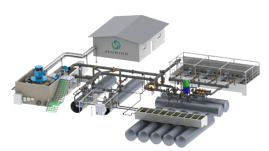
Grid stability is seriously threatened by “Dunkelflautes,” which are extended periods of poor solar and wind output that occur in places like Germany and other central European countries. In order to help utilities, grid operators, and traders manage the intermittent nature of renewable energy sources and stabilize the power markets, Augwind’s AirBattery provides a robust buffer that can provide backup for up to months.
Through the innovative way of compressed air storage and pumped hydroelectric principles, Augwind’s ground-breaking AirBattery system compresses and decompresses air on a massive scale by circulating water between underground chambers.
Depending on the demand and the geomorphic structure of the cavern, excess energy is utilized to compress air to pressures ranging from 50 bar to more than 200 bar. The pressurized air is then sent into enormous underground caverns that are bigger than the Empire State building.
With a typical cavern having the capacity to store enough compressed air to generate 3–8 GWh of electricity, the excess renewable energy is efficiently stored for periods when the sun does not shine and the wind does not blow.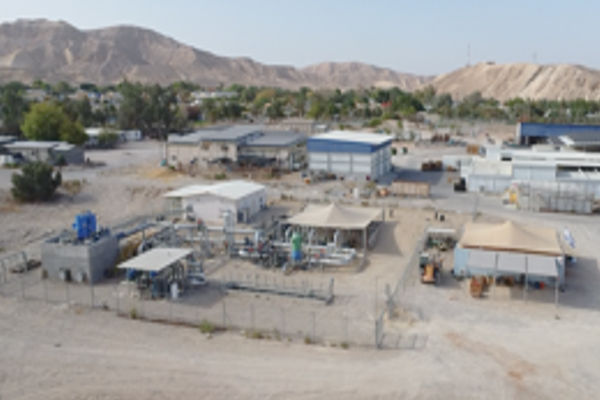
Simply recirculating the high-pressure air through the water-filled chambers allows the system to recover energy, which is then used to spin a turbine and produce power.
At its AirBattery demonstration facility in Israel, Augwind has already achieved an AC-to-AC round-trip efficiency of 47%, confirming that commercial installations would surpass 60%.
A mined salt cavern that is ideal for this kind of long-duration energy storage will be used in the construction of Augwind’s first commercial-scale AirBattery facility in Germany.
As Europe scrambles to boost renewable energy penetration above 50%, the cavern will act as a low-cost, high-capacity compressed-air reservoir, allowing for scalable and economical energy storage for up to several months.
Why is AirBattery the energy storage solution for the future?
Compared with the alternatives for long-term energy storage such as Lithium-Ion batteries and hydro storage, Augwind’s unique AirBattery system offers incredibly economical and sustainable storage for up to months at a time.
The technology doesn’t rely on critical minerals used to make batteries, including Lithium, Nickel, Cobalt, or Manganese, many of which rely on complex supply chains dominated by Chinese manufacturers. The AirBattery relies on locally sourced supplies and labour and a minimal volume or water which is maintained in a closed system.
In addition, the AirBattery system can be operated by using locally produced renewable excess electricity. This reduces the stress on the electricity grid and simultaneously strengthens the independence from volatile international energy markets.
How does the AirBattery support the energy transition?
Economic resilience: By absorbing surplus wind and solar energy, it reduces exposure to the price volatility of international commodity markets (e.g. oil, gas, coal and nuclear), helping to stabilise electricity costs for consumers and industry alike.
Geopolitical stability: It directly enhances security of supply by reducing dependency on energy imports. This role has gained fresh urgency in the wake of Germany’s exposure during the Russian gas crisis, severely threatening the German energy supply. AirBattery helps shield the energy system from such external shocks.
Addressing the Energy Goal Policy Triangle
The AirBattery solution contributes meaningfully to all three pillars of the so-called “Energy Policy Goal Triangle”, a guiding framework in energy policy:
Security of supply: By storing energy for weeks, AirBattery provides backup power during extended periods of low renewable generation (Dunkelflaute), which will become more frequent as Germany phases out coal and nuclear while accelerating its transition to renewables.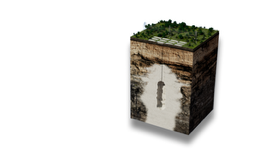
Affordability: The system reduces multi-billion-Euro re-dispatch costs where wind and solar parks are paid to shut down during oversupply (curtailment), in addition air batteries can prevent unnecessary energy grid expansions. Since storage occurs near major wind generation areas (especially off- an onshore in Northern Germany), the grid can avoid transporting peak loads southward, where coal and nuclear previously served. Ultimately resulting in a decrease in short-term price volatility.
Sustainability: By enabling more effective integration of solar and wind energy, AirBattery reduces pressure on and supports the expansion of renewable energy projects. This accelerates the transition while reducing long-term energy costs for industry and households.
Key Advantages of the AirBattery System:
- Unlimited duration potential (limited only by the caverns volume)
- Exceptionally low cost per kWh for multiweek durations (10-15 USD per kWh). ***
- Minimal environmental footprint (land and water)
- Modular and scalable design (several MWs per module, multiplied to grid-scale)
- Novel combination of proven, established technologies (pumped hydro storage and CAES)
- Stable, local supply chain structures ensure long-term reliability and scalability
- The modular structure insures high redundancy and therefore, high availability
- Strengthens energy transition and lessens dependence on international markets
- Cost and performance have been validated by Fichtner Group, renowned German engineering company
Augwind is now collaborating closely with local cavern owners, utilities, energy traders, and industrial off takers to get permits and complete the system design, with an initial target commissioning window of 2027–2028.
In addition to demonstrating Augwind’s Hydraulic CAES’s techno-economic feasibility, the project will set the stage for a wider rollout throughout Europe by 2030.
Leadership Comments
Or Yogev Founder and CEO of Augwind said, “This is more than a project; it’s a milestone for achieving net zero. With the AirBattery, we’re introducing a storage solution that finally matches the scale and rhythm of renewable energy. Germany’s redundant salt caverns, industrial leadership, and climate ambition make it the perfect launchpad for our first commercial deployment. Our goal is to become Europe’s preferred partner for multiweek storage solutions. With this German launch, we are proving that long term energy storage to balance the grid is not only technically feasible, but it’s economically sound.”
** The 60 – 65% figure has been calculated according to the study on potential for h2 storage in Europe, we convert h2 to compressed air by ration of 1:28 in terms of energy potential (energy density).
*** https://www.pnnl.gov/projects/esgc-cost-performance/compressed-air-energy-storage

