



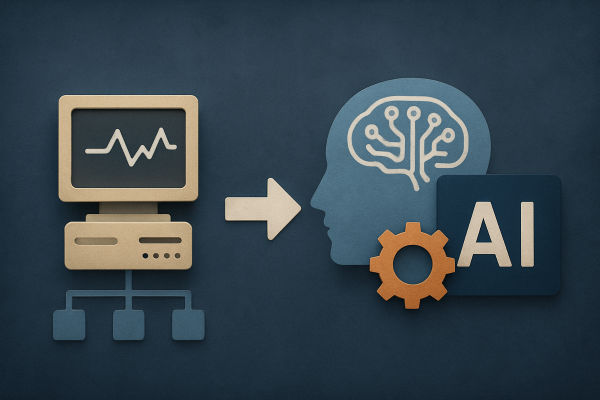
AI integration into legacy systems follows phased strategies using middleware, APIs, and hybrid cloud approaches to enable modernization without full replacements.
Assess and Plan Integration
To start with AI integration into legacy systems, begin with thorough audits of legacy infrastructure to map dependencies, data flows, and bottlenecks using AI-driven tools for automated analysis. Prioritize high-impact use cases like predictive maintenance or fraud detection where quick ROI demonstrates value.
Establish data governance early, cleansing and standardizing legacy data formats through ETL pipelines to ensure AI model compatibility. Collaborate across IT, data, and AI teams via shared roadmaps to align on constraints and milestones.
Leverage Non-Intrusive Bridges
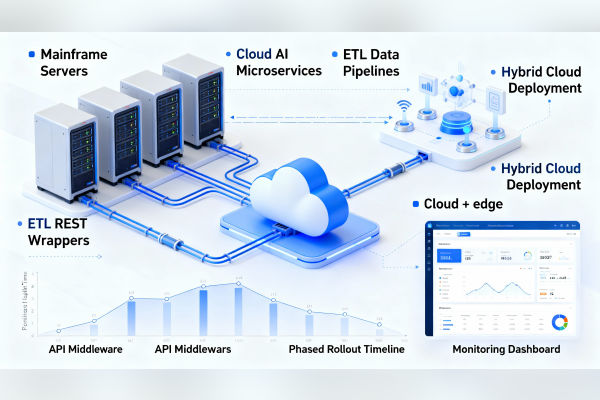
Deploy middleware and API wrappers as translators between legacy cores and AI modules, avoiding code alterations for AI integration into legacy systems.
RESTful services and microservices enable modular data exchange, with implementations often completing in 6-12 weeks versus months for overhauls.
Combine RPA with AI to mimic user interactions on inflexible systems, automating repetitive tasks like report generation. AI gateways handle data processing and security, simplifying connections for analytics or chatbots.
 Adopt Hybrid and Phased Deployment
Use cloud-based AIaaS for heavy computation while keeping sensitive workloads on-premises, balancing cost and security.
Edge AI processes real-time data locally on IoT devices, reducing latency and bandwidth strain on legacy networks.
Run AI in shadow mode first, processing live data without influencing decisions to validate accuracy, then phase rollout to subsets of users with fallbacks. This minimizes disruption and builds confidence.
| Strategy | Key Tools/Methods | Benefits |
| Middleware/APIs | RESTful services, wrappers | Non-intrusive data exchange |
| Hybrid Cloud | AIaaS, edge computing | Scalability without hardware upgrades |
| Phased Rollout | Shadow mode, subsets | Risk reduction, quick wins |
| RPA + AI | Bot automation | Handles inflexible interfaces |
| Data Pipelines | ETL processes | Quality standardization |
Optimize Data and Security
Implement transformation pipelines to convert legacy formats into AI-ready structures, using ML for anomaly detection during migration.
Generative AI maps dependencies and reimagines architectures, accelerating refactoring.
Address vulnerabilities by isolating AI via containers, enforcing encryption, and monitoring for biases in legacy-sourced data. Regular audits ensure compliance during integration.
Monitor, Scale, and Iterate
Post-integration, deploy observability tools for performance tracking, enabling AI-driven auto-scaling and predictive fixes. Gather metrics on ROI—like 30-50% labor cost cuts—to justify expansions.