



A new STEMlab TI board that Red Pitaya and Texas Instruments(TI) co-developed has been announced. The two companies will jointly demonstrate the product’s capabilities at the Laser World of Photonics trade event in Munich, Germany, from June 24–27, 2025.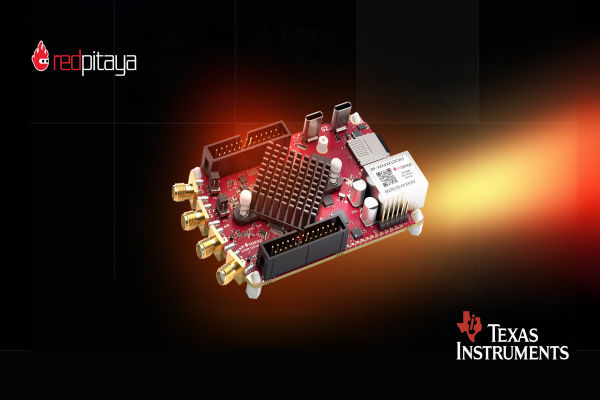
Advanced signal processing applications in photonics, sensors, and lab automation are the focus of the new STEMlab TI board.
It makes use of essential TI components to provide ultra-low jitter performance, low power consumption, and excellent precision in a small form size.
Two Versions of the Board Will Be Available:
- STEMlab 125-14 TI, featuring the TI ADC3664 (14-bit, 125 MSps) with high SNR (signal-to-noise ratio), low power, low latency, and on-chip digital filtering and digital downconversion (DDC).
- STEMlab 65-16 TI, built around the Texas Instruments ADC3663 dual-channel 16-bit, 65 MSps ADC (analog-to-digital converter), optimized for low-noise and ultra-low-power operation.
Both Models Also Include:
- TI DAC2904Y, a 14-bit, 125 MSps dual-channel digital-to-analog converter
- TI LMK03318, a programmable ultra-low jitter clock generator
- 2 RF inputs (125 MSps 14-bit or 62.5 MSps 16-bit with DC coupling)
- 2 RF outputs (125 MSps 14-bit)
- Xilinx Z7020 FPGA with CPU and Ethernet connectivity
TI and Red Pitaya already have a technical connection, which is strengthened by this launch.
TI has utilized Red Pitaya’s hardware in a number of development contexts, so this co-developed board is a logical next step, fusing reliable open hardware with tighter integration and improved end-user performance possibilities.
Leadership Comments
“Whether in photonics, aerospace, or industrial sensing, our customers increasingly need modular, ultra-low-latency tools that can be tailored to demanding environments,” said Mateja Lampe Rupnik, CEO at Red Pitaya. “The collaboration with Texas Instruments helps us meet that need with even greater performance and precision, while keeping our commitment to accessibility and openness.”
“The ADC3664 family of high-speed SAR ADCs bridge the gap between high-speed and precision performance to ease the design of digital control loops with high dynamic range and low latency while reducing power consumption,” said Dalton Stringer, marketing engineer at Texas Instruments. ”Texas Instruments’ partnership with Red Pitaya showcases how these benefits can be implemented in a software-defined instrument that can be adapted to many high-speed control applications in research, education, and industrial.”
Designed with customization in mind, the STEMlab TI platform offers engineers a reliable and flexible foundation for building and scaling high-speed applications.
To Know More: CLICK HERE