





The world of telecommunications is on the brink of a transformative leap, as 6G begins to take shape. Beyond faster speeds, 6G networks promises to redefine connectivity, fuel new industries, and enable previously impossible experiences.
In 2026, the innovation race is already heating up, with global tech giants vying to set standards and win market dominance. Here’s a deep dive into potential 6G networks use cases, plus a spotlight on the top companies worth watching—and the flagship products that may shape the next era of wireless.
The Next Leap: What Makes 6G Networks Different?
6G isn’t just a “faster 5G.” It represents a shift to seamless, ultra-low latency, hyper-connected networks. Peak data rates are predicted to reach up to 1 Tbps with latency as low as 0.1 ms.
It’s a leap that can enable applications like real-time holographic telepresence, fully autonomous systems, intelligent edge networks, and environmental sensing at global scale.
With deep integration of AI at the network layer, 6G moves from connectivity to cognition—an enabler of a truly immersive digital universe.
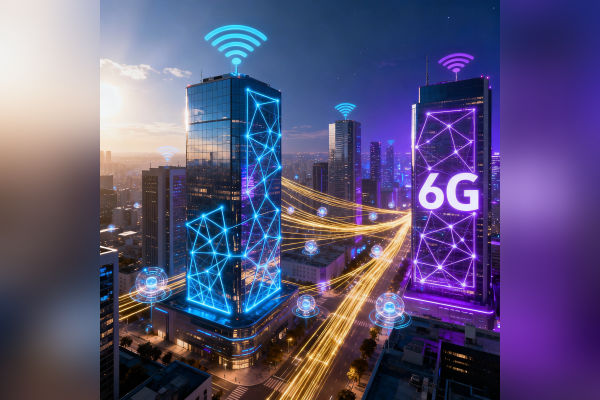
6G Use Cases for 2026 and Beyond
-
Real-time Holographic Communication
Imagine collaborative meetings where participants interact holographically as lifelike avatars. 6G networks can stream ultra-high-resolution 3D video with imperceptible latency, finally making sci-fi telepresence a practical tool for business, medicine, and entertainment.
- Key specs required: Sub-millisecond latency, millions of simultaneous data streams, secure edge processing.
-
Autonomous Mobility and Smart Infrastructure
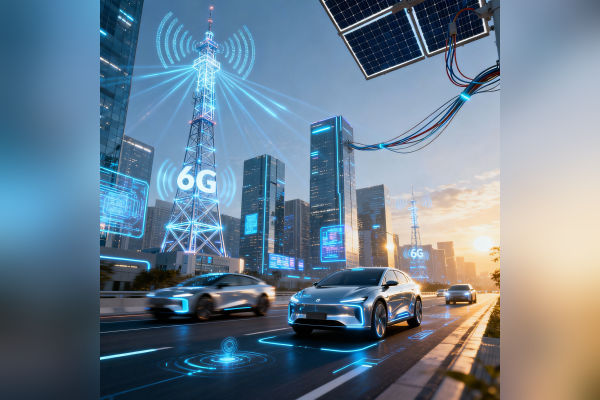
6G networks is set to unlock mass deployment of autonomous vehicles, drones, and robotics—all communicating with each other and infrastructure in real time. With advanced sensor fusion and deterministic networking, fleets of cars, trucks, and aerial vehicles can operate in harmony without centralized control.
- Key specs required: Ubiquitous coverage in urban and rural zones, deterministic reliability, AI-powered orchestration.
-
Ambient Intelligence and Extended Reality (XR)
6G brings true spatial computing, where ambient intelligence infuses every physical environment. XR headsets, smart glasses, and wearable interfaces will seamlessly blend data, objects, and experiences on demand—from retail and healthcare to education and entertainment.
- Key specs required: Context-aware data slicing, location-based services, energy-efficient edge devices.
-
Industrial Automation and Digital Twins
Factories, supply chains, and energy grids will adopt real-time digital twins, powered by 6G sensors and AI to optimize processes, detect anomalies, and forecast disruptions. With robust private 6G networks, critical infrastructure can operate securely and autonomously.
- Key specs required: Massive machine-type communications, ultra-precise positioning, end-to-end security features.
-
Environmental Sensing and Global Connectivity
6G networks will incorporate advanced sensing capabilities, monitoring climate, pollution, and natural disasters in real time on a global scale. Integrated with satellites and terrestrial infrastructure, this opens a new frontier in planetary stewardship and universal access.
- Key specs required: Integration with non-terrestrial networks, low-power wide-area coverage, quantum-safe security.

Top Companies to Watch in 2026: Flagship Products, Specs, and Features
Major tech players are pouring billions into 6G research, and several are unveiling pre-commercial flagship products that will likely define the landscape.
Samsung Electronics
Flagship Product: 6G Core Platform (Prototype)
- Specs: Capable of supporting peak data rates up to 1 Tbps, with native support for AI-centric orchestration and real-time context recognition.
- Features: Integrated holographic codec engine, advanced spectrum management using adaptive AI, and quantum-resistant cybersecurity modules.
- Why It Matters: Samsung’s platform targets both carriers and enterprises, making it a flexible heart of future 6G networks. Their expertise in both handset and network infrastructure positions them as a leader in end-to-end solutions.
Nokia
Flagship Product: Nokia Horizon 6G Infrastructure Suite
- Specs: Sub-0.1 ms latency, support for spectrum from sub-THz to mmWave bands, fully virtualized radio access core.
- Features: Industrial-grade private networking, end-to-end digital twin enablement, and seamless interoperability between land, air, and space networks.
- Why It Matters: Known for robust enterprise solutions, Nokia’s suite is designed for industrial automation and mission-critical systems, making them a favorite in manufacturing, logistics, and smart city deployments.
Ericsson
Flagship Product: Ericsson Cognitive Edge Connect
- Specs: Distributed AI processing at the edge, deterministic networking, and ultra-reliable low latency communication (URLLC).
- Features: Intelligent spectrum allocation, edge-native security, and zero-trust authentication protocols.
- Why It Matters: Ericsson’s edge-first architecture taps into cloud and AI fusion, powering real-time XR and autonomous infrastructure. Their cross-industry focus covers telecommunications, automotive, and energy sectors.
Huawei
Flagship Product: Huawei FutureLink 6G
- Specs: Integrated support for 6G satellite-to-ground networks, scalable to billions of device connections, multi-layered network virtualization.
- Features: Advanced multi-beam directional antennas, quantum encryption modules, and ambient sensing capabilities for environmental monitoring.
- Why It Matters: With leadership in both terrestrial and satellite networks, Huawei’s platform aims for universal connectivity and next-gen digital services in both urban and remote regions.
Qualcomm
Flagship Product: Snapdragon 6G Modem Platform
- Specs: 6G multi-band support up to sub-THz, on-chip AI accelerators, and advanced power management for wearables and XR devices.
- Features: Real-time holographic streaming, low-power operation for IoT and edge devices, and security built with post-quantum cryptography.
- Why It Matters: Qualcomm’s platform is geared to power the new generation of consumer and enterprise devices—from smartphones to smart glasses and autonomous vehicles.
Intel
Flagship Product: Intel 6G Edge Fusion
- Specs: Native integration of AI and real-time analytics, massive device connectivity, and support for distributed digital twin networks.
- Features: Seamless hybrid cloud integration, ultra-fast edge data harmonization, and adaptive real-time orchestration.
- Why It Matters: Intel’s developer-first approach and ecosystem partnerships accelerate the pace of industrial transformation, making digital twins and ambient intelligence a reality in critical sectors.
Apple
Flagship Product: Apple Reality Network
- Specs: Secure ultra-wideband connectivity, deep integration with XR hardware, latency under 1 ms for immersive experiences.
- Features: Private 6G mesh for wearables, real-time spatial computing APIs, and environment-aware privacy safeguards.
- Why It Matters: Apple is betting big on XR as the next major computing paradigm. Their network and chips are tuned for seamless user experiences and personal safety through environmental context recognition.
Flagship Product: Google QuantumNet 6G
- Specs: Federated AI learning for network optimization, quantum encryption engines, and adaptive bandwidth management for cloud-centric applications.
- Features: Native integration with cloud infrastructure, contextual data routing, and dynamic application prioritization for AI-driven services.
- Why It Matters: Google’s data and AI leadership translate into intelligent network services powering smart cities, autonomous services, and spatial search at unprecedented scale.
Sony
Flagship Product: Sony Immersive Edge
- Specs: Optimized for high-fidelity streaming to XR headsets, ultra-low latency audio-visual codecs, and secure edge access for entertainment platforms.
- Features: Adaptive content streaming, joint device-cloud rendering, and real-time multiview support for collaborative digital media.
- Why It Matters: Sony’s deep roots in media and entertainment position Immersive Edge as the backbone for next-gen digital experiences—from movies and concerts to online gaming.
Cisco
Flagship Product: Cisco SecureMesh 6G
- Specs: Dynamic micro-network orchestration, enterprise-grade security, and universal device onboarding with intelligent quality-of-service management.
- Features: AI-driven performance optimization, multi-cloud compatibility, and granular threat detection for distributed environments.
- Why It Matters: Cisco’s strength in enterprise networking and security protocols is set to redefine secure connectivity—making private 6G mesh networks viable for complex, large-scale organizations.
2026 Outlook: Strategic and Technology Challenges
Spectrum and Standards Race
While many flagship products are in prototype or early deployment stages, 2026 will be marked by a race for spectrum. Sub-THz bands, never before used in commercial wireless, present both huge opportunities and design challenges. Companies are racing to develop antennas and chips capable of exploiting these bands efficiently while meeting global standards under development.
Security in a Quantum Era
With quantum computers on the horizon, 6G platforms feature quantum-safe encryption and multi-layered security. Network providers are partnering with cybersecurity firms to ensure privacy and data integrity for billions of new devices linking people, machines, and environments.
Edge Intelligence and AI Integration
6G marks a paradigm shift: network intelligence moves from the centralized cloud to the distributed edge. Companies are embedding AI processors into network hardware and end devices, allowing for real-time distributed decision-making, autonomous orchestration, and adaptive services tailored to user context and environment.
6G Networks Transition From Vision To Reality
As 6G transitions from vision to reality, companies are pioneering technologies and platforms that will fundamentally reshape connectivity, computing, and daily life.
From ultra-realistic holographic communication to planetary-scale environmental monitoring, 6G is the backbone for the digital universe of 2030 and beyond.
In 2026, these leading firms and their flagship products represent the cutting edge—each offering unique approaches to speed, intelligence, security, and flexibility.

