





After releasing its flagship 63xx Series AWG a year ago, Spectrum Instrumentation now offers a new Direct Digital Synthesis (DDS) option, greatly enhancing the capabilities of these already powerful instruments.
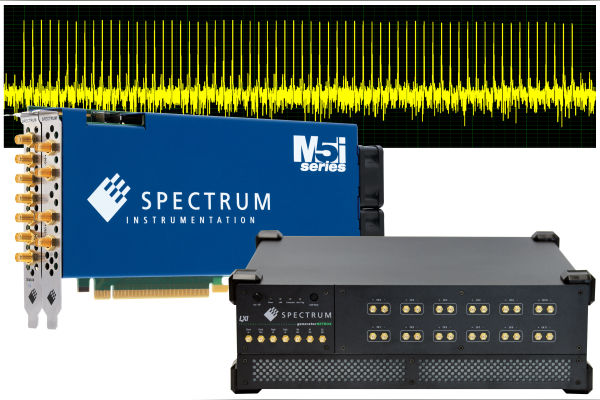
The products generate waveforms at up to 10 Gigasamples per second (GS/s) in AWG mode, with 16-bit resolution and bandwidths up to 3.9 GHz. The 63xx series AWG provide 64 individual sine waves on a single generator channel in the new DDS-Mode, each of which changes frequency, amplitude, and phase in increments of just 3.2 ns.
This is a simple method for creating trains of waveforms, frequency sweeps, or precisely adjustable references for use in quantum research, semiconductor testing, communications, industrial, medical, and imaging systems.
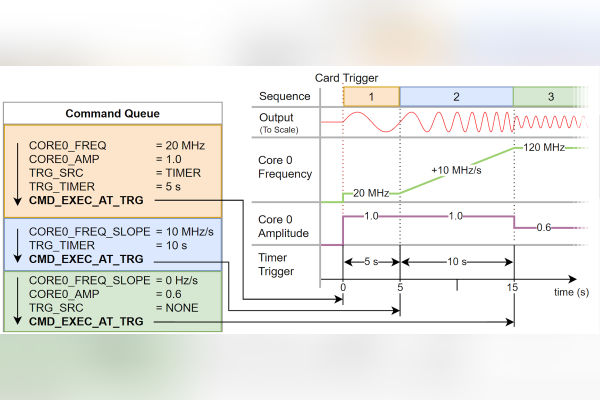
Each AWG channel can generate up to 64 programmable sinewave cores, sometimes referred to as carriers or tones, due to the new DDS option. Frequency, amplitude, phase, and frequency and amplitude slopes can all be separately adjusted for each core.
Simple commands that can be carried out in real time or as part of preloaded sequences govern all modifications. Because of this, DDS-enabled devices are perfect for applications that need high-purity, agile signal sources.
The 63xx series of Arbitrary Waveform Generators consists of 22 variants in two hardware formats:
• The PCIe-based M5i.63xx models are designed for direct installation into PCs and are ideal where space and high-speed data transfer are critical. These cards support one or two channels, with output rates of 3.2 to 10 GS/s (5 GS/s for dual-channel mode). Up to eight cards can be synchronized using Spectrum’s Star-Hub system, enabling up to 16 synchronous channels and as many as 512 DDS cores.
• The NETBOX instruments (DN2.63x and DN6.63x models) are LXI compliant standalone devices optimized for benchtop or rack-mounted use. They connect to PCs or networks via Ethernet. Available in configurations from 1 to 12 synchronous channels, they support output rates of 3.2 or 5 GS/s, or up to 6 channels at 10 GS/s, with the ability to program up to 384 DDS cores.
Crucially, none of the AWG’s initial capabilities are compromised by the addition of DDS. With sophisticated operation modes like single shot, loop, gated, streaming, and more, users still have complete control over arbitrary waveform playback. Users are essentially given two instruments in one as a result.
All Spectrum devices include a high-level Python API, software support for Windows and Linux, and programming examples in popular languages including Python, MATLAB, C++, and LabVIEW. The 63xx Series AWG DDS option is currently accessible and comes with free firmware and software updates as well as lifetime technical support straight from Spectrum Instrumentation engineers.
Leadership Comments
Oliver Rovini, CTO at Spectrum Instrumentation, reports: “A major advantage of the DDS upgrade is its efficiency. Rather than streaming large waveform datasets, users can control signal characteristics through compact command sequences stored in the device’s memory. Millions of commands can be saved and executed with precise timing resolution as low as 3.2 ns, without jitter or glitches. Settings can be triggered externally, by internal timers, or on command – enabling complex pulse trains, frequency sweeps, AM/FM modulation, and custom-shaped transitions”.
Link to the product video (5 min): https://youtu.be/PoT0cReolRE

