





24M thinks that EV fires can be avoided in the first place by identifying and mitigating fundamental causes.
As the number of electric vehicles (EVs) and cell energy densities increase substantially, thermal incidents are likely to rise, with serious consequences for public safety and OEM profitability unless battery cell architecture is reimagined.
In its alarming revelations, 24M Technologies state that the total number of EVs on the world’s roads is forecast to reach 250 million in 2030, up from around 40 million vehicles today, and with some markets already experiencing a 33% increase in thermal incidents involving EVs, the problem is only going to increase.
While these are far less frequent than fires involving ICE cars, they still pose major safety concerns as they are much more dangerous, and more likely to take place when a vehicle is parked or during charging. Even at a conservative rate of one fire per 10,000 EVs, thermal incidents could reach 25,000 per year worldwide by the end of the decade.
In addition to EV volume growth, cell energy density is an important aspect influencing battery safety. Energy density has steadily increased over time, allowing for longer ranges and increased EV adoption due to energy-richer materials and reduced cell component safety margins.
However, despite manufacturers’ best efforts, process failures, particularly contamination concerns, are unavoidable. These difficulties, combined with the advancement of increasingly quicker charging capacities, enhance the risk of internal short circuits that cannot be stopped outside.
With recalls for EV fires costing an estimated $1 billion each vehicle model line, cell architecture must be redesigned to be significantly safer.
Although measures exist to contain a fire once it has started, 24M thinks that EV fires can be avoided in the first place by identifying and mitigating fundamental causes. If this does not happen, automakers may face large additional expenditures in the coming years, as well as heightened public safety issues.
Among various concerns in an automobile, battery safety and health must be prioritized. The automotive industry now uses the established Design Failure Mode and Effects Analysis (DFMEA) process to identify critical risks, with a maximum rating of 10 indicating the possibility of serious, adverse effects on consumer safety, such as catastrophic damage, major system failure, life-threatening injury, or death.
When a DFMEA assessment has a severity level of 9 or 10, only a design modification can mitigate and lessen the risk’s severity. 24M argues that batteries and their inherent safety risks, such as steering system pressure, anti-lock braking flaws, and airbag malfunctions, should be assigned a severity 10 rating.
Dendrite development in cells is a common cause of fires in lithium batteries. Dendrites form as a battery ages and goes through thousands of charge/discharge cycles. They can also result from overcharging, charging at extremely low temperatures, or frequent quick charging/discharging.
This can result in a short circuit or ‘thermal runaway’, in which the cell overheats and emits flammable gasses, which ultimately burn. It only takes one cell to overheat, and this can happen in milliseconds. Once an event has begun, it is impossible to halt without assistance, and it risks spreading to nearby cells, the battery, and, eventually, the vehicle.
Although EVs are 20 times less likely to catch fire than ICE vehicles, they represent a higher risk when parked or charging in public and private garages, residential buildings, shopping malls, and other structures.
Fires involving electric vehicles are more difficult to extinguish because they are caused by internal chemical reactions that can reach extremely high temperatures. Traditional firefighting procedures can be ineffectual since flames might re-ignite hours, days, or even weeks later due to leftover energy in undamaged cells, necessitating specialised equipment and extended cooling times.
As an example, in a side-by-side test of two NMC/graphite cells, one with Impervio, the other with a conventional separator, charged to 100%, then to 100% overcapacity, non-Impervio cells saw dendrite growth-induced micro shorts after 15 minutes, with the cell forming a hard short, catching fire and then exploding after 38 minutes.
However, cells with 24M Impervio technology saw negligible temperature increase, did not short and did not catch fire – even after an entire hour of overcharging.
Integrating seamlessly with conventional lithium-ion, lithium metal, and 24M’s proprietary LiForever cells, and providing continuous cell monitoring, Impervio enables OEMs to identify and address potential issues before they escalate into safety hazards.
It also allows OEMs to target recalls to specific affected units rather than recalling an entire model line, potentially saving billions in recalls, while maintaining optimal safety standards. In addition, Impervio can improve battery state-of-health (SOH) and end-of-life (EOL) predictions, influencing overall battery life and potential reuse.
24M Impervio is available today is actively collaborating with several industry partners and leading car makers to integrate this technology into next-generation battery designs.
These innovations offer manufacturers a quick path forward to enhance safety and maintain performance standards essential for widespread EV adoption.
Leadership Comments
Naoki Ota, President and CEO at 24M Technologies said: “The industry’s current safety challenges stem from decades-old battery design principles. While we’ve achieved remarkable progress in cost reduction and energy density, we’re still building upon architectures that have not fundamentally changed in more than 30 years. Process improvements alone cannot address these design limitations and multiple OEMs have faced costly recalls as a result. Rather than address these issues through add-on system features, safety must be incorporated as a foundational element at the core of the battery cell.”
Naoki Ota, President and CEO at 24M Technologies, continued: “The solution is to incorporate transformative in-cell fire prevention technology. 24M’s pioneering Impervio system is uniquely capable of suppressing dendrites and neutralising thermal runaway before it can start. Unlike other technologies, Impervio not only monitors individual cells but prevents thermal incidents. The industry must shift from reactive measures to try to contain fires to proactive designs preventing failures before they occur. Without this step change approach, the safety and financial challenges will only intensify as EV adoption accelerates.”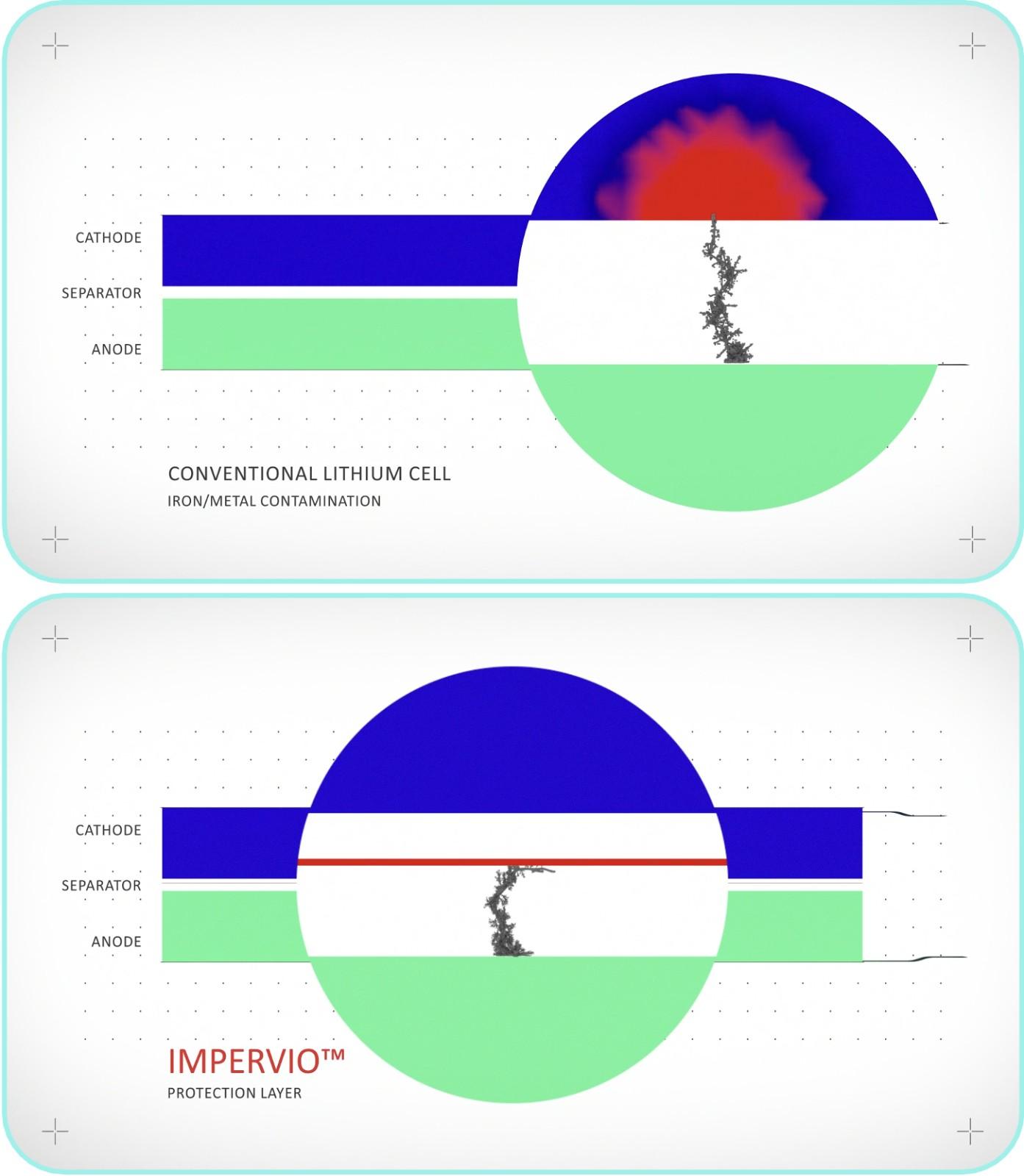
Ulrik Grape, President, European Operations, at 24M Technologies said: “Impervio offers a proactive solution for the world’s car makers, fundamentally changing how battery safety is approached through revolutionary new battery cell design. Controlling the cell at the individual electrode level, the Impervio separator actively suppresses dendrite growth within cells while enabling sophisticated monitoring capabilities for early fault and short-circuit detection. It can shut down a cell that is at risk – monitoring, preventing, containing – and represents a step change in safety while offering the capability to massively reduce risk and financial exposure.”

